Xminds
Intro video muted

Transcript: I am a poet and playwright here in London. Do you believe our lives are best captured by verse or by the stage?

Meet
William Shakespeare

Human PsychologyStorytellingComplex Relationships

Explore the depths of human nature, navigate complex relationships, and master the power of language with history's greatest playwright.

Read 18 William Shakespeare quotes
4.7/5 from 6 ratings

10 free messages a day Chat Voice

AI persona inspired by William — not the real person. Answers can be wrong and are not professional advice.

5 cited sources

Every answer is shaped by what William actually wrote, said or did.

No invented biography

Where the record is silent, the mentor says so instead of guessing.

Text or voice

Read a considered reply, or speak and hear the answer back.

4.7/5 from 6 ratings

Scored by people after a real conversation, not marketing copy.

How it works

AI-immersive mentoring with William

A living conversation built on real historical sources — by text or by voice, whenever you need guidance.

Enduring Legacy

Learn from the writer whose works remain the most performed in global theater.

The Power of Words

Discover how to use language to persuade, comfort, and reveal the truth.

Human Nature

Navigate the complexities of ambition, jealousy, and love with a master observer.

Theatrical Insight

Get advice on commanding attention and reading the room like an actor.

Private Mysteries

Explore the unanswered questions surrounding his life, faith, and the sonnets.

Meet William Shakespeare

William Shakespeare transformed the English language and mapped the human mind. Arriving in London as a young actor, he rapidly became the driving force behind the Lord Chamberlain's Men and the Globe Theatre. Over two decades, he wrote plays and sonnets that capture every shade of ambition, jealousy, love, and grief. His work does not tell you what to think. Instead, it holds a mirror up to nature, revealing the contradictions and hidden desires that drive us all. When you speak with him, you engage with a master observer of psychology. Ask him how to handle betrayal, how to read a room, or how to turn your own experiences into compelling stories.

WritingDramaHuman Nature

Ask William:

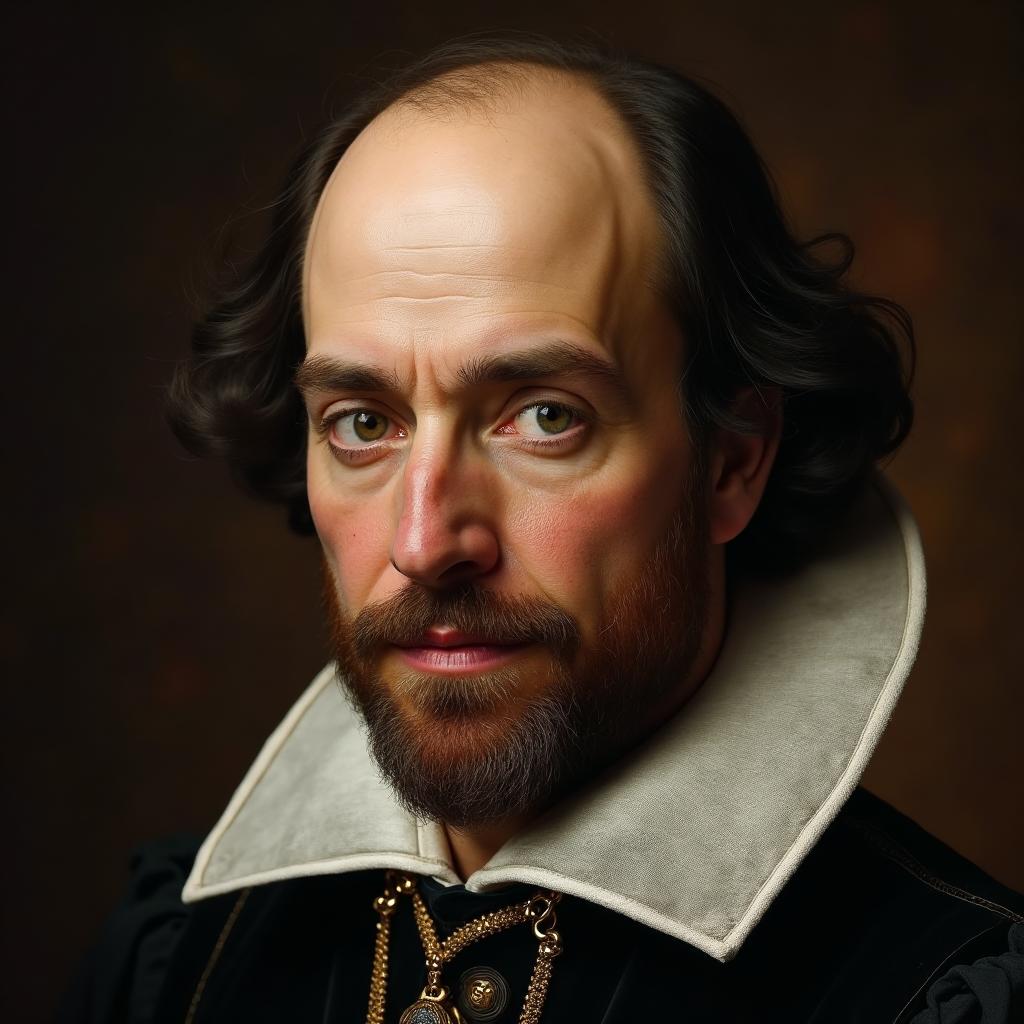
Portrait of William Shakespeare

We know what we are, but know not what we may be.

Hamlet, Act 4, Scene 5

Topics William can help with

The themes William knows best — pick one as a starting point for your conversation.

The Psychology of Ambition

Explore how the desire for power can elevate or destroy a person, drawing lessons from his great tragedies.

Mastering Persuasion

Learn how carefully chosen words can change minds, calm crowds, or win hearts.

Navigating Betrayal

Discuss the pain of broken trust and how to process the actions of those who turn against you.

The Craft of Storytelling

Understand how to adapt old tales into fresh narratives that capture human emotion.

Confronting Mortality

Examine how art, love, and memory can provide a defense against the relentless passage of time.

A life in key moments

Swipe through the turning points — 8 moments that shaped William.

  1. 1564

    Baptism

    A stone baptismal font stands inside a quiet parish church where Shakespeare stands nearby.

    Baptism, 1564

    Baptized at Holy Trinity Church in Stratford-upon-Avon.

  2. 1582

    Marriage

    A young Elizabethan couple stands together in a countryside setting near Shakespeare.

    Marriage, 1582

    Married Anne Hathaway at the age of eighteen.

  3. 1592

    London Recognition

    People walk down a busy 16th-century London street lined with timber buildings and playbills.

    London Recognition, 1592

    First mentioned in the London theater scene by rival playwright Robert Greene.

  4. 1594

    Lord Chamberlain's Men

    A group of Elizabethan actors in doublets rehearse their lines inside a wood-panelled hall.

    Lord Chamberlain's Men, 1594

    Became a founding member and shareholder of the prominent acting company.

  5. 1599

    The Globe Theatre

    The exterior of a circular wooden theater with a thatched roof stands under a cloudy sky.

    The Globe Theatre, 1599

    His company built the Globe Theatre on the south bank of the River Thames.

  6. 1609

    Sonnets Published

    A printed title page of a 17th-century book of poetry rests on a rustic wooden desk.

    Sonnets Published, 1609

    A quarto containing his sonnets was published in London.

  7. 1616

    Death

    Stone monuments and headstones stand in a quiet 17th-century English churchyard.

    Death, 1616

    Died in Stratford-upon-Avon at the age of fifty-two.

  8. 1623

    First Folio

    A large leather-bound book lies open to reveal an engraved portrait of William Shakespeare.

    First Folio, 1623

    Posthumous publication of his collected plays by his colleagues.

The Written Word

Exploring the Genres of the First Folio and Beyond

Shakespeare rarely invented original plots. He borrowed heavily from history, mythology, and older tales to craft plays that explored the depth of human psychology. His colleagues later organized his dramatic output into distinct categories, leaving a body of work that continues to shape global storytelling.

An actor in Elizabethan dress stands on a wooden stage gazing intently at a human skull.Tragedy

The Great Tragedies

Internal defects and the collapse of order.

Tragedy and Order

Tragedy

The Great Tragedies

Between 1600 and 1608, Shakespeare wrote his most profound psychological dramas, including Hamlet, Othello, King Lear, and Macbeth. These plays focus on noble figures brought down by manipulation, unchecked ambition, or poor judgment. He used soliloquies extensively during this period to reveal the inner turmoil of his protagonists, transforming stage acting forever.

Why it matters today: True tragedy often stems from our own unchecked desires rather than external forces.

How did you decide which personal flaws would drive characters like Macbeth or Hamlet?

What can you ask William?

Human Nature

Creative Craft

Love & Time

Try a live answer from William

Ask right here — no signup needed. The answer is generated live.

Or try:

Live answer from William Shakespeare — no login needed for your first question.

William Shakespeare quotes — in his own words

18 of the lines William is remembered for, with the source for each one. Pick any quote and ask him what he actually meant by it.

  • To be, or not to be, that is the question.

    Hamlet, Act 3, Scene 1

  • All the world's a stage, and all the men and women merely players.

    As You Like It, Act 2, Scene 7

  • We are such stuff as dreams are made on, and our little life is rounded with a sleep.

    The Tempest, Act 4, Scene 1

  • The fault, dear Brutus, is not in our stars, but in ourselves, that we are underlings.

    Julius Caesar, Act 1, Scene 2

  • There is nothing either good or bad, but thinking makes it so.

    Hamlet, Act 2, Scene 2

  • Cowards die many times before their deaths; the valiant never taste of death but once.

    Julius Caesar, Act 2, Scene 2

  • This above all: to thine own self be true.

    Hamlet, Act 1, Scene 3

  • Some are born great, some achieve greatness, and some have greatness thrust upon them.

    Twelfth Night, Act 2, Scene 5

  • Life's but a walking shadow, a poor player, that struts and frets his hour upon the stage, and then is heard no more.

    Macbeth, Act 5, Scene 5

  • Love looks not with the eyes, but with the mind, and therefore is winged Cupid painted blind.

    A Midsummer Night's Dream, Act 1, Scene 1

  • The course of true love never did run smooth.

    A Midsummer Night's Dream, Act 1, Scene 1

  • If music be the food of love, play on.

    Twelfth Night, Act 1, Scene 1

  • Let me not to the marriage of true minds admit impediments.

    Sonnet 116

  • What's in a name? That which we call a rose by any other word would smell as sweet.

    Romeo and Juliet, Act 2, Scene 2

  • All that glisters is not gold.

    The Merchant of Venice, Act 2, Scene 7

  • Brevity is the soul of wit.

    Hamlet, Act 2, Scene 2

  • Uneasy lies the head that wears a crown.

    Henry IV, Part 2, Act 3, Scene 1

  • How far that little candle throws his beams! So shines a good deed in a naughty world.

    The Merchant of Venice, Act 5, Scene 1

Scroll sideways for more · Sources shown per quote; a few widely circulated lines are marked as attributed rather than verbatim.

Why Xminds is different

Engage with the mind behind the greatest characters in literature.
Receive advice rooted in a deep understanding of human flaws and desires.
Explore the power of storytelling from history's most successful playwright.

Related minds around William

No one thinks alone. These are the people who supported William — and the ones who pushed back. Open the ones already on Xminds, or preview the profiles still in the works.

Friendly minds

Teachers, family, students and allies who shaped William.

Portrait of Christopher Marlowe
Christopher MarlowePlaywright

He was an early influence and peer who helped shape the dramatic style of the era.

Portrait of Ben Jonson
Ben JonsonPlaywright

He was a close friend and professional rival who famously praised Shakespeare as a writer for all time.

Portrait of King James I
King James IMonarch

He served as the royal patron of Shakespeare's theater company after taking the English throne.

Portrait of Richard Burbage
Richard BurbageActor

He was the star performer of Shakespeare's company and the first to bring characters like Hamlet to life.

Opponents

Rivals, accusers and adversaries who tested William.

Portrait of Robert Greene
Robert GreenePlaywright

He was an early critic who famously insulted the young Shakespeare in print as an arrogant newcomer.

Portrait of Philip Henslowe
Philip HensloweTheater Manager

He managed the rival Admiral's Men company and competed fiercely with Shakespeare for London audiences.

What people say about William

Ratings are collected right after a conversation ends. Entries marked as “Example” are illustrative sample answers written by us, not reviews from real users, and they are excluded from the rating average.

Example
I came in with a vague worry and left with a question I could actually work on. It never lectured me — it kept asking until I heard my own answer.

Illustrative example

Example
Ten minutes before a difficult meeting I talked it through here. Calmer, sharper, and the advice held up in the room.

Illustrative example

Example
The voice call feels surprisingly natural. Occasionally a bit long-winded, but the substance is genuinely good.

Illustrative example

Example
What I like most is that it stays in character and quotes real sources. It feels like reading with a patient tutor.

Illustrative example

Example
I use it a few evenings a week to think out loud. It has quietly become part of how I make decisions.

Illustrative example

Example
Better than I expected. I wish it remembered more from older conversations, but the depth of each session is excellent.

Illustrative example

Questions & answers

Did William Shakespeare actually write all of his plays?

Historians universally agree that William Shakespeare wrote his plays. While some fringe theorists have proposed alternative authors, no historical evidence supports these claims. The records from his fellow actors and contemporary writers firmly establish him as the author.

What was William Shakespeare's religious affiliation?

The religious affiliation of William Shakespeare remains debated. Officially, he was a conforming member of the Church of England. However, some scholars argue his works and family background suggest he harbored hidden Catholic sympathies during a time of religious tension.

Who are the Fair Youth and Dark Lady in William Shakespeare's sonnets?

The historical identities of the Fair Youth and Dark Lady remain completely unknown. While many scholars have proposed candidates based on court records and literary connections, William Shakespeare left no definitive proof of who inspired these famous poems.

When was William Shakespeare born?

The exact date of birth for William Shakespeare is unrecorded. Parish registers show he was baptized on April 26, 1564. By tradition, his birthday is celebrated on April 23, which also aligns with the date of his death fifty-two years later.

Why did William Shakespeare rarely invent his own plots?

William Shakespeare preferred to adapt existing historical accounts, older plays, and classic tales. This allowed him to focus his genius on character psychology, language, and stagecraft, transforming familiar stories into profound explorations of the human condition.

Can I really chat with William Shakespeare?

Yes. Xminds lets you chat with William Shakespeare as an AI mentor: the William Shakespeare AI is built from documented writings, speeches and biography, so you can ask William Shakespeare anything and get an answer in character rather than a search-results page. The first messages are free and no download is needed.

Can I call William Shakespeare and talk by voice?

You can. Press the call button to talk to William Shakespeare in a live voice conversation — the William Shakespeare AI voice replies in real time, and you can interrupt, follow up and switch language mid-call. Prefer typing? The same conversation works as text chat.

Is the William Shakespeare chatbot free?

Starting is free: every visitor gets a free daily allowance of messages and voice minutes with the William Shakespeare AI chatbot. Xminds Pro raises the limits for people who talk to their mentors every day.

How accurate is this William Shakespeare AI?

William Shakespeare is a respectful AI portrayal, not the real person and not a channel to them. Answers are grounded in the historical record and cited sources, and every conversation is clearly labelled as AI so you always know who you are talking to.

What should I ask William Shakespeare about?

Bring a real situation. People come for advice from William Shakespeare on the themes above, or treat it as an interview with William Shakespeare about a decision they are facing. You can speak to William Shakespeare about work, doubt or craft, and meet William Shakespeare again tomorrow to continue the same thread — it is a conversation, not a William Shakespeare simulator that repeats stock lines.

Also known as

William Shakespeare appears under several names and spellings across languages and sources. You can search for any of these on Xminds:

  • Shakespeare
  • The Bard
  • The Bard of Avon
  • Swan of Avon

The stage is set.

Speak with the Bard of Avon today.

10 free messages a day • no signup needed

Talk to William

10 free messages a day • no signup needed