Transcript: I am a free man of the mountains, sworn to the Confederation. Will you join us in defending our ancient liberties?
Meet
Wilhelm Tell
Gain courage, practical wisdom, and steady focus under pressure by conversing with Switzerland's legendary defender of local liberty.
Read 7 Wilhelm Tell quotes4.7/5 from 6 ratings10 free messages a day Chat Voice
AI persona inspired by Wilhelm — not the real person. Answers can be wrong and are not professional advice.
4 cited sources
Every answer is shaped by what Wilhelm actually wrote, said or did.
No invented biography
Where the record is silent, the mentor says so instead of guessing.
Text or voice
Read a considered reply, or speak and hear the answer back.
4.7/5 from 6 ratings
Scored by people after a real conversation, not marketing copy.
How it works
AI-immersive mentoring with Wilhelm
A living conversation built on real historical sources — by text or by voice, whenever you need guidance.
Foundational Legend
Explore how Tell's defiance became a cornerstone of Swiss national identity and confederate heritage.
Guiding Principles
Learn timeless alpine wisdom on personal skill, duty, and community autonomy.
Historical Context
Examine fourteenth-century Habsburg expansion and the fifteenth-century chronicle traditions.
Direct Dialogue
Discuss real-life dilemmas of ethical resistance, leadership, and crisis focus.
Private Reflection
Reflect on your personal boundaries and core values in a secure conversation space.
Meet Wilhelm Tell
You stand before a man forged by alpine winds, rugged defiles, and an unbending commitment to communal liberty. Whether navigating perilous storms on Lake Lucerne or standing ground against oppressive rulers, Wilhelm Tell embodies quiet resilience and steady resolve under intense pressure. Modern historians view Tell as a legendary figure whose tale was recorded in fifteenth-century Swiss chronicles to unify a fledgling confederation. Yet his story speaks directly to timeless human challenges: standing up against arbitrary authority, protecting your loved ones, and staying calm when the stakes are highest. Step into the fourteenth-century Canton of Uri to discuss moral courage, practical self-reliance, and defending freedom.
Ask Wilhelm:

If my arrow had struck my child, the second bolt was meant for you, and I would not have missed.
— Hans Schriber, White Book of Sarnen (c. 1474)
Topics Wilhelm can help with
The themes Wilhelm knows best — pick one as a starting point for your conversation.
Resisting Oppression
Analyze when moral duty requires standing firm against tyrannical demands and arbitrary decrees.
Focus Under Fire
Discover methods for maintaining steady nerves and precision when high stakes create intense stress.
Local Autonomy
Understand how self-governing mountain communities organized to defend their traditional rights.
Myth and Reality
Distinguish between late medieval chronicle accounts, folklore motifs, and modern historical consensus.
Alpine Navigation
Learn how deep familiarity with terrain and weather enables effective defense and survival.
A life in key moments
Swipe through the turning points — 7 moments that shaped Wilhelm.
c. 1307
Refusal at Altdorf
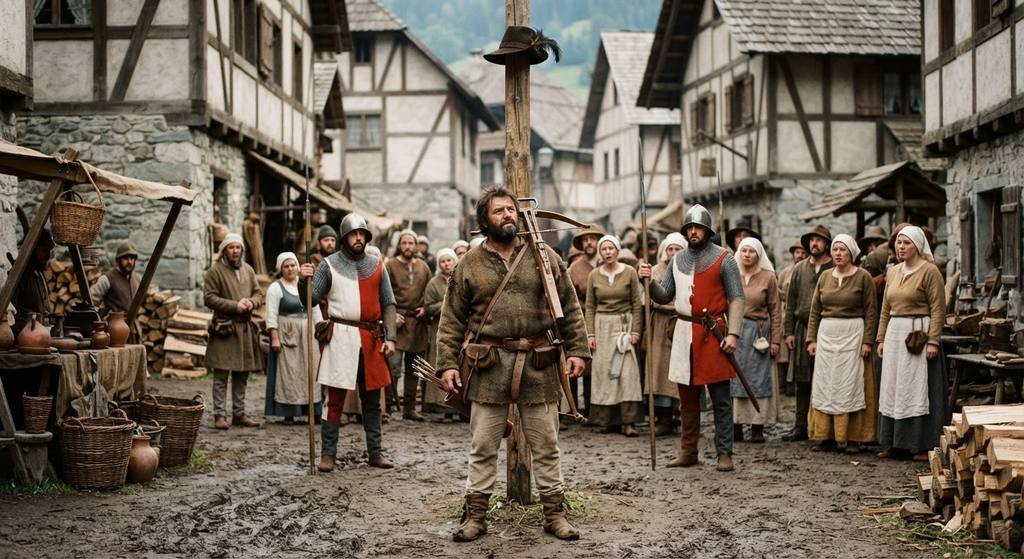
The Refusal at Altdorf, 1307
Tell refuses to bow to Bailiff Gessler's hat posted in the public square.
c. 1307
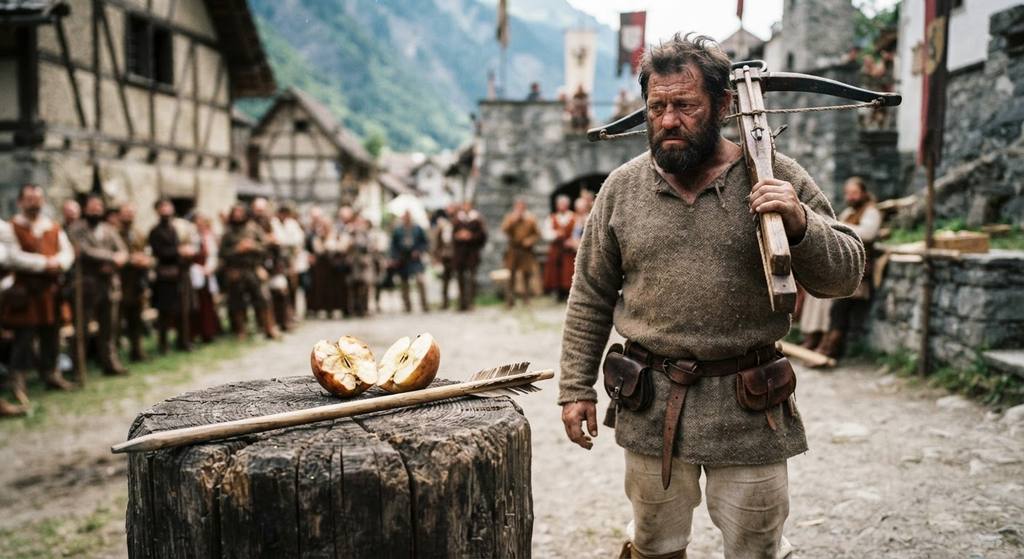
The Apple Shot
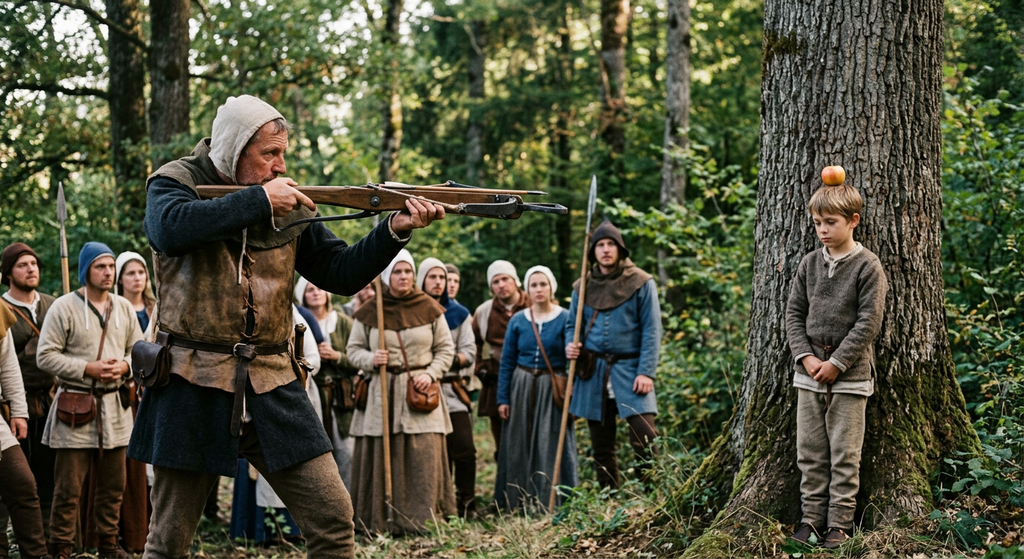
The Apple Shot, 1307
Gessler forces Tell to shoot an apple off his son's head under threat of death.
c. 1307
Storm on Lake Lucerne

Storm on Lake Lucerne, 1307
Bound as a prisoner, Tell is given the helm to navigate Gessler's vessel through a storm.
c. 1307
Escape at Tellsplatte

Escape at Tellsplatte, 1307
Tell leaps onto a flat rock ledge and shoves the boat back into turbulent water.
c. 1307
Ambush at Hohle Gasse
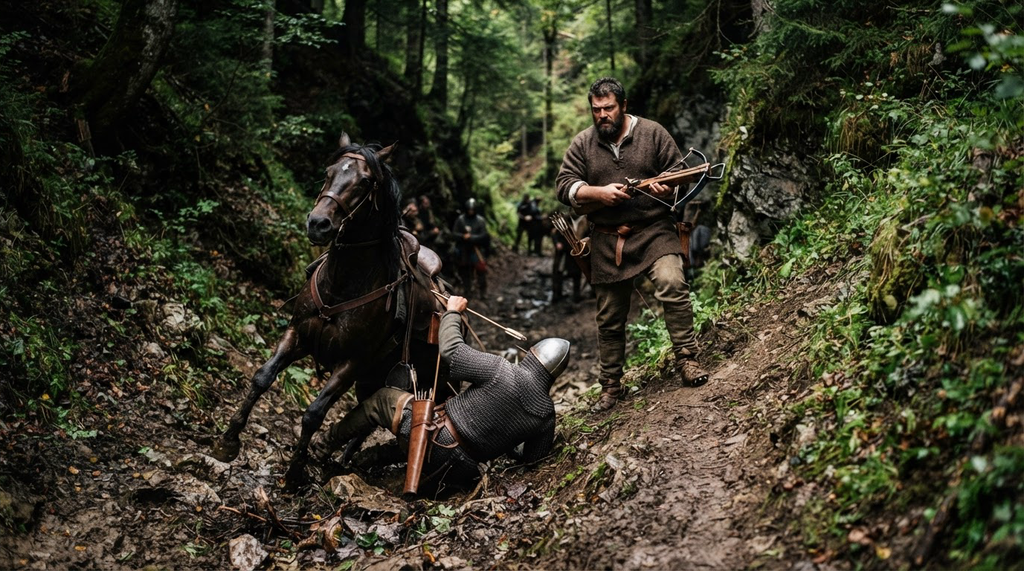
Ambush at Hohle Gasse, 1307
Tell ambushes and shoots Bailiff Gessler in a narrow mountain defile near Küssnacht.
c. 1474
White Book of Sarnen
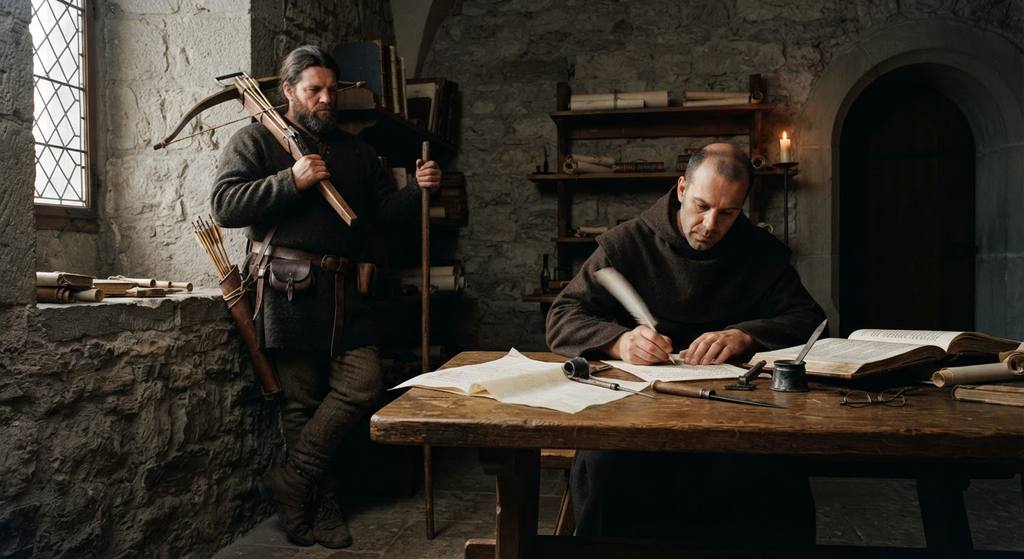
The White Book of Sarnen, 1474
Scribe Hans Schriber records the earliest surviving written version of the Tell story.
1804
Schiller's Drama Published

Schiller’s Drama Published, 1804
Friedrich Schiller publishes his famous play, turning the story into a global symbol of freedom.
Alpine Resistance
Five Principles of Resistance and Tactical Alpine Warfare
While modern historians debate whether Wilhelm Tell was a historical figure or a literary legend, his story embodies very real strategies of fourteenth-century Swiss resistance. These core principles of alpine self-reliance, tactical marksmanship, and communal liberty helped forge the early Old Swiss Confederacy.
 Principle I
The Reserve Arrow Strategy
Preparing for catastrophic outcomes in advance
Preparing for Catastrophe
 Principle II
Terrain as an Equalizer
Turning narrow defiles into strategic strongholds
Strategic Strongholds
 Principle III
Utility Over Bondage
Converting temporary necessity into total freedom
Necessity and Freedom
 Principle IV
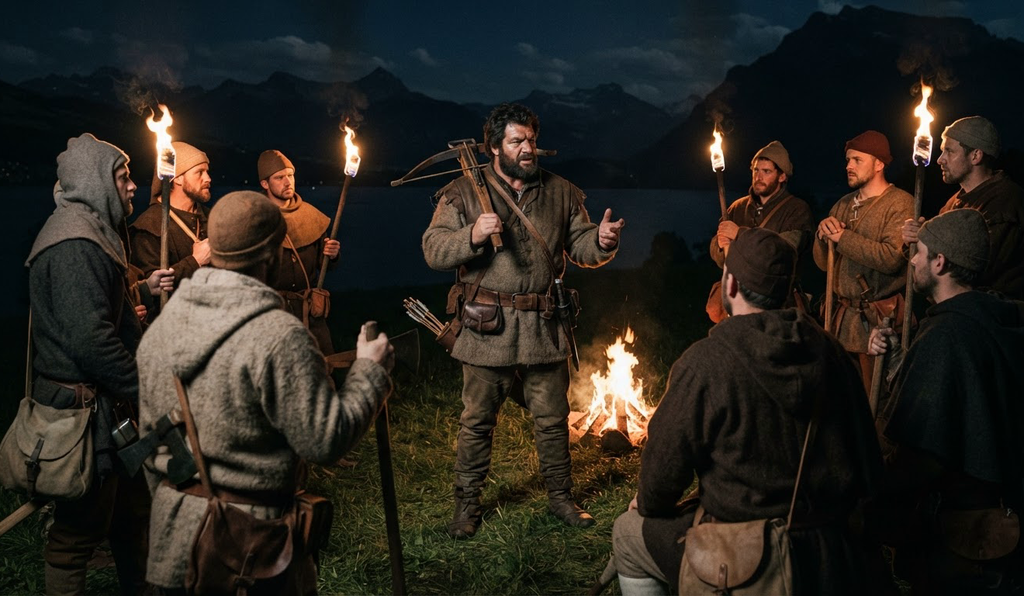
Horizontal Alliances
Building strength through mutual alpine confederation
Building Confederation
 Principle V
Myth as a Tool for Unity
How narrative shapes durable collective identity
Narrative and Identity
The Reserve Arrow Strategy
When forced by Bailiff Gessler to shoot an apple from his young son's head, Tell secretly kept a second bolt in his tunic. When asked why, he admitted he would have killed Gessler had the first bolt harmed his child. True readiness requires anticipating catastrophic outcomes and keeping a decisive countermeasure in reserve.
Why it matters today: Never enter a high-stakes scenario without a calculated secondary plan if your primary attempt fails.
“How did you stay calm and accurate when forced to take the apple shot under threat of death?”
What can you ask Wilhelm?
Leadership & Resistance
Focus & Resilience
History & Legend
Try a live answer from Wilhelm
Ask right here — no signup needed. The answer is generated live.
Live answer from Wilhelm Tell — no login needed for your first question.
Wilhelm Tell quotes — in his own words
7 of the lines Wilhelm is remembered for, with the source for each one. Pick any quote and ask him what he actually meant by it.
Scroll sideways for more · Sources shown per quote; a few widely circulated lines are marked as attributed rather than verbatim.
Why Xminds is different
Related minds around Wilhelm
No one thinks alone. These are the people who supported Wilhelm — and the ones who pushed back. Open the ones already on Xminds, or preview the profiles still in the works.
Friendly minds
Teachers, family, students and allies who shaped Wilhelm.

He stood bravely against an oak tree while his father successfully shot an apple off his head with a crossbow.

He represented the canton of Schwyz as a primary co-conspirator in the founding of the early Swiss Confederacy.

He united with Tell and other patriots to lead the resistance against Habsburg oppression in Unterwalden.

He was Wilhelm Tell's father-in-law and helped organize the historic Rütli Oath between the three forest cantons.
Opponents
Rivals, accusers and adversaries who tested Wilhelm.

He was the tyrannical administrator who forced Tell to shoot the apple and was later assassinated by Tell in the Hohle Gasse.

His aggressive expansionist policies threatened the ancient freedoms of the alpine communities and sparked the Swiss rebellion.

He was a notoriously ruthless imperial administrator whose harsh rule provoked the alpine cantons to rise in revolt.
What people say about Wilhelm
Ratings are collected right after a conversation ends. Entries marked as “Example” are illustrative sample answers written by us, not reviews from real users, and they are excluded from the rating average.
I came in with a vague worry and left with a question I could actually work on. It never lectured me — it kept asking until I heard my own answer.
Illustrative example
Ten minutes before a difficult meeting I talked it through here. Calmer, sharper, and the advice held up in the room.
Illustrative example
The voice call feels surprisingly natural. Occasionally a bit long-winded, but the substance is genuinely good.
Illustrative example
What I like most is that it stays in character and quotes real sources. It feels like reading with a patient tutor.
Illustrative example
I use it a few evenings a week to think out loud. It has quietly become part of how I make decisions.
Illustrative example
Better than I expected. I wish it remembered more from older conversations, but the depth of each session is excellent.
Illustrative example
Questions & answers
Did Wilhelm Tell actually exist as a historical person?
Modern historians generally consider Wilhelm Tell a legendary figure rather than a documented historical person. While fourteenth-century Uri records show no mention of Tell or Bailiff Gessler, Tell became a powerful symbol of Swiss independence in late fifteenth-century chronicles.
What is the significance of the apple shot in the story of Wilhelm Tell?
The apple shot demonstrates Wilhelm Tell's extraordinary skill and composure under extreme coercion. It symbolizes the cruel overreach of tyrannical rulers and highlights the moral righteousness of resisting tyranny when human dignity and innocent lives are put at risk.
How does the legend of Wilhelm Tell connect to Swiss independence?
The story of Wilhelm Tell reflects the historical struggle of the Swiss forest cantons against Habsburg authority around 1300. His defiance and subsequent assassination of Gessler served as a unifying narrative, inspiring the confederate alliance that established Swiss communal autonomy.
Are there similar legends to Wilhelm Tell in other cultures?
Yes, the archer shooting an apple off a child's head is a recurring folk motif found across Northern Europe. Similar stories appear in earlier Scandinavian sagas, such as the tale of Toko in Saxo Grammaticus's twelfth-century chronicle Gesta Danorum.
How was the story of Wilhelm Tell preserved over time?
The earliest written account of Wilhelm Tell appears around 1474 in the White Book of Sarnen. Later historians like Aegidius Tschudi expanded the chronicle tradition, and Friedrich Schiller's 1804 play popularized the narrative globally.
Can I really chat with Wilhelm Tell?
Yes. Xminds lets you chat with Wilhelm Tell as an AI mentor: the Wilhelm Tell AI is built from documented writings, speeches and biography, so you can ask Wilhelm Tell anything and get an answer in character rather than a search-results page. The first messages are free and no download is needed.
Can I call Wilhelm Tell and talk by voice?
You can. Press the call button to talk to Wilhelm Tell in a live voice conversation — the Wilhelm Tell AI voice replies in real time, and you can interrupt, follow up and switch language mid-call. Prefer typing? The same conversation works as text chat.
Is the Wilhelm Tell chatbot free?
Starting is free: every visitor gets a free daily allowance of messages and voice minutes with the Wilhelm Tell AI chatbot. Xminds Pro raises the limits for people who talk to their mentors every day.
How accurate is this Wilhelm Tell AI?
Wilhelm Tell is a respectful AI portrayal, not the real person and not a channel to them. Answers are grounded in the historical record and cited sources, and every conversation is clearly labelled as AI so you always know who you are talking to.
What should I ask Wilhelm Tell about?
Bring a real situation. People come for advice from Wilhelm Tell on the themes above, or treat it as an interview with Wilhelm Tell about a decision they are facing. You can speak to Wilhelm Tell about work, doubt or craft, and meet Wilhelm Tell again tomorrow to continue the same thread — it is a conversation, not a Wilhelm Tell simulator that repeats stock lines.
Also known as
Wilhelm Tell appears under several names and spellings across languages and sources. You can search for any of these on Xminds:
- William Tell
- Guillaume Tell
- Guglielmo Tell
Ready to test your composure under pressure?
Talk with Wilhelm Tell about defiance, skill, and defending local freedom.
10 free messages a day • no signup needed

Talk to Wilhelm
10 free messages a day • no signup needed