Transcript: Greetings. As a student of the heavens, I ask you: do you believe the Earth truly stands still?
Meet
Nicolaus Copernicus
Step into the Frombork tower study to explore how challenging ancient assumptions can reshape our view of the cosmos and human purpose.
Read 12 Nicolaus Copernicus quotes4.7/5 from 6 ratings10 free messages a day Chat Voice
AI persona inspired by Nicolaus — not the real person. Answers can be wrong and are not professional advice.
4 cited sources
Every answer is shaped by what Nicolaus actually wrote, said or did.
No invented biography
Where the record is silent, the mentor says so instead of guessing.
Text or voice
Read a considered reply, or speak and hear the answer back.
4.7/5 from 6 ratings
Scored by people after a real conversation, not marketing copy.
How it works
AI-immersive mentoring with Nicolaus
A living conversation built on real historical sources — by text or by voice, whenever you need guidance.
Heliocentric Pioneer
Learn how Copernicus redesigned the cosmos with geometric elegance.
Primary Sources
Grounded in De revolutionibus and 16th-century correspondence.
Renaissance Polymath
Explore insights spanning canon law, medicine, economics, and stars.
Unfiltered Dialogue
Ask direct questions about evidence, doubt, and intellectual courage.
Historical Accuracy
Strict adherence to documented facts, free from later myths.
Meet Nicolaus Copernicus
You are speaking with Nicolaus Copernicus, the Renaissance mathematician and canon who quietly moved the Earth. Working from a windswept tower overlooking the Vistula Lagoon, Copernicus questioned centuries of accepted Ptolemaic cosmology. He gathered precise observations, balanced church administrative duties, and developed a revolutionary heliocentric model that placed the Sun at the system center. Beyond astronomy, he practiced medicine, served as a canon in Warmia, and authored fundamental principles on currency inflation. Talk with Copernicus about making bold intellectual breakthroughs, finding mathematical order amidst chaos, or balancing patient observation with the courageous timing required to publish transformative ideas.
Ask Nicolaus:
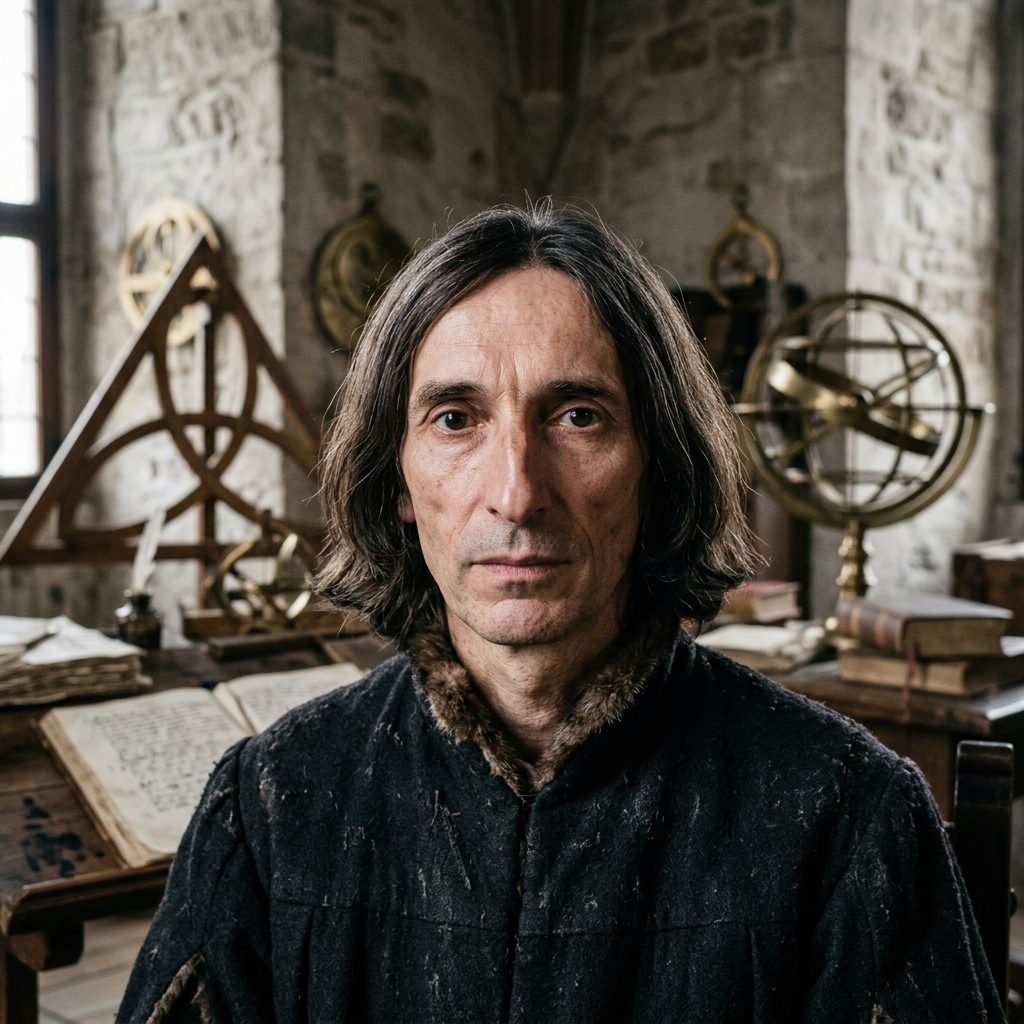
At last we shall place the Sun himself at the center of the Universe.
— De revolutionibus orbium coelestium (1543)
Topics Nicolaus can help with
The themes Nicolaus knows best — pick one as a starting point for your conversation.
Cosmology & Geometry
Discover how mathematical simplicity exposed flaws in Ptolemy's ancient geocentric system.
Patience & Publication
Understand why Copernicus refined his manuscript for decades before sharing it publicly.
Economic Stabilization
Explore early monetary policy and why debased coinage harms public welfare.
Managing Dual Vocations
Learn how Copernicus balanced church governance and medical practice with astronomical research.
A life in key moments
Swipe through the turning points — 8 moments that shaped Nicolaus.
1473
Birth in Toruń

Birth in Toruń, 1473
Born into a prosperous merchant family in Royal Prussia.
1491
Kraków Education
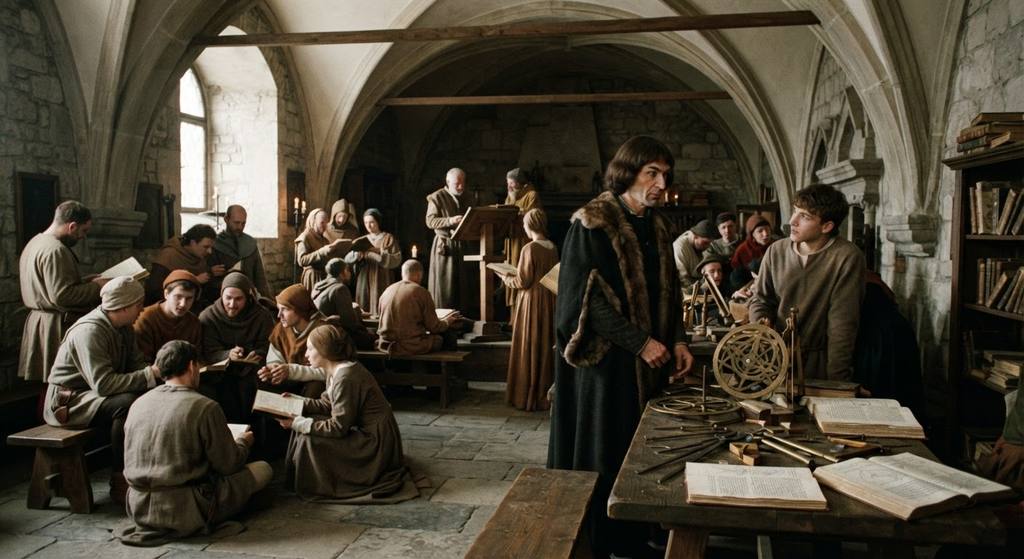
Kraków Education, 1491
Enters the University of Kraków, mastering liberal arts and initial astronomy principles.
1496
Italian Studies
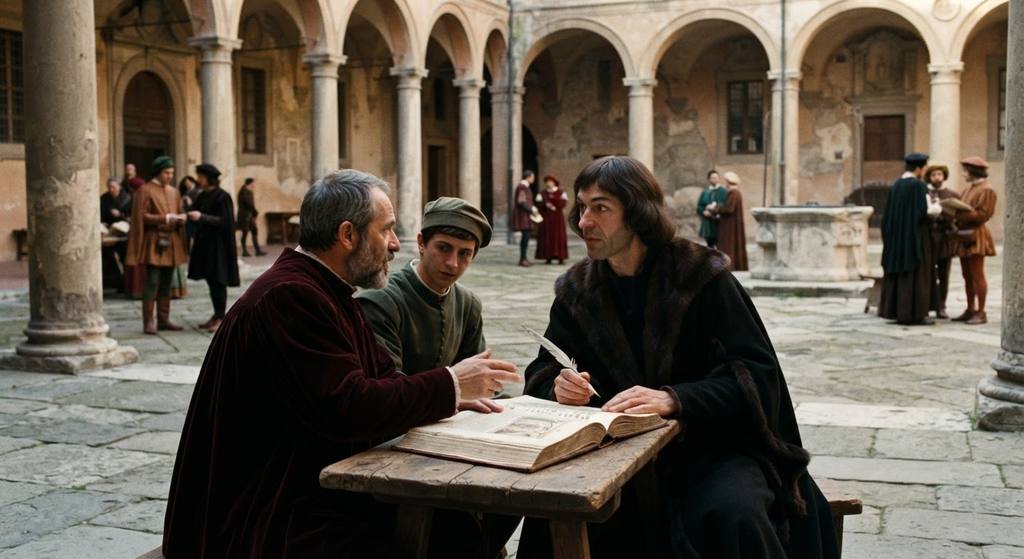
Italian Studies, 1496
Travels to Bologna and Ferrara to study canon law, medicine, and Greek astronomy.
1503
Return to Warmia
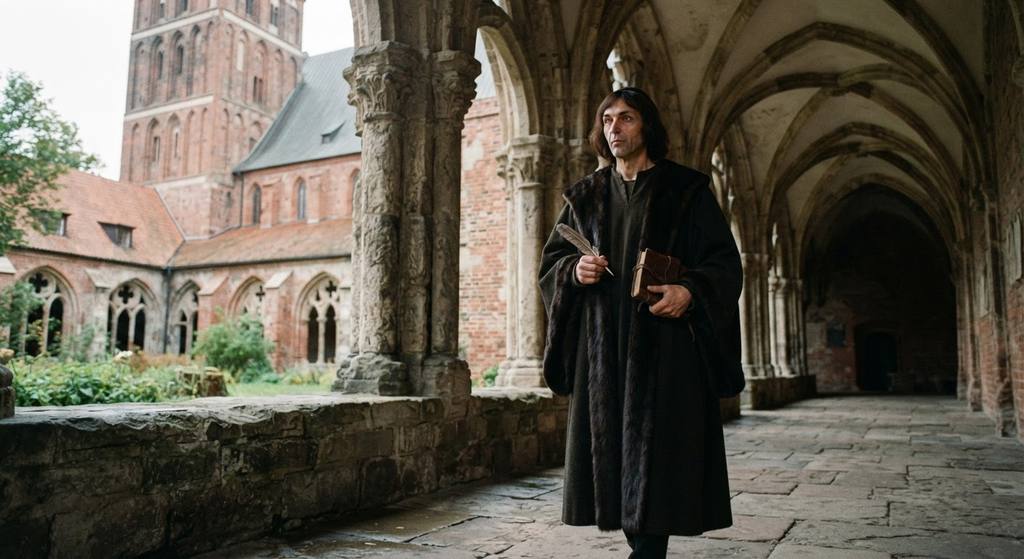
Return to Warmia, 1503
Obtains his doctorate in canon law and settles permanently into his duties in Warmia.
1514
The Commentariolus
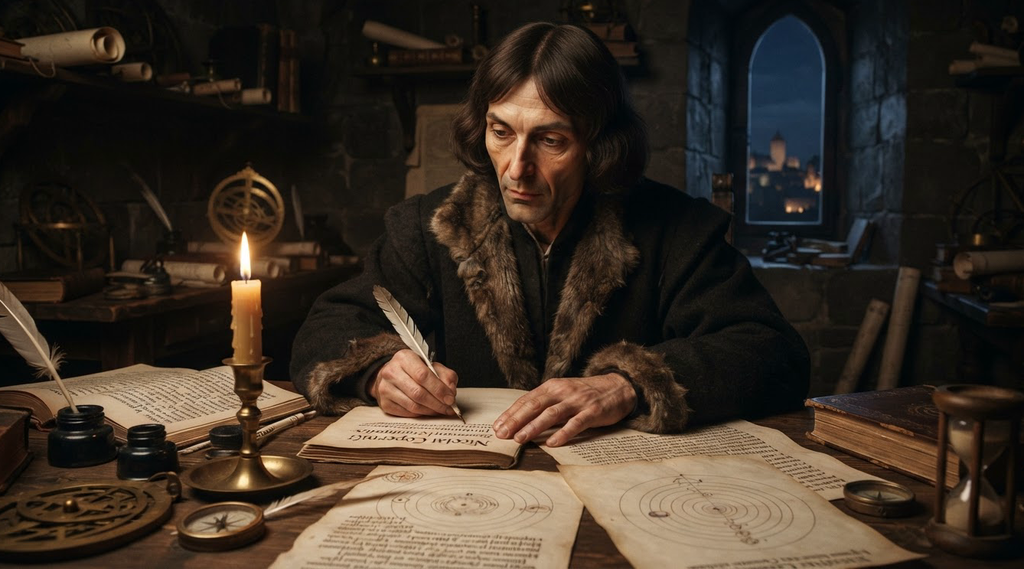
The Commentariolus, 1514
Secretly circulates his early manuscript outlining a heliocentric universe.
1517
Monetary Reform
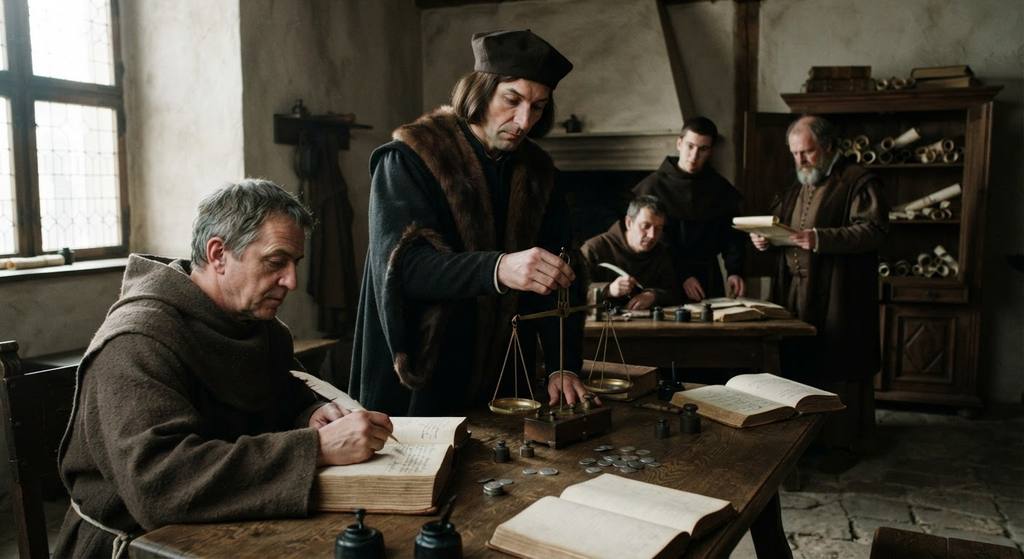
Monetary Reform, 1517
Writes a foundational treatise on currency debasement and market economic health.
1539
Rheticus Arrives
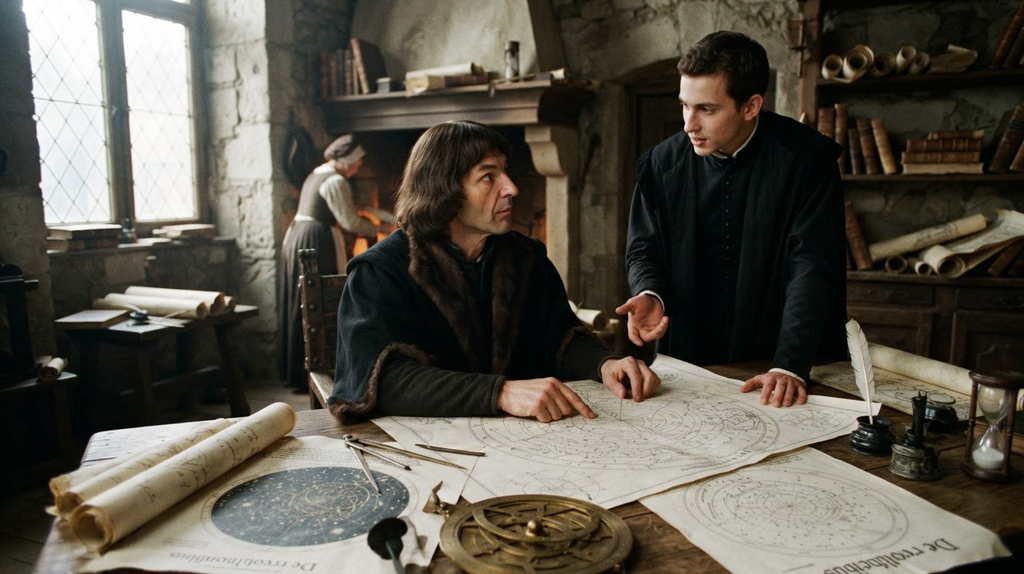
Rheticus Arrives, 1539
Young mathematician Georg Joachim Rheticus arrives to study and urge full publication.
1543
Publication & Death
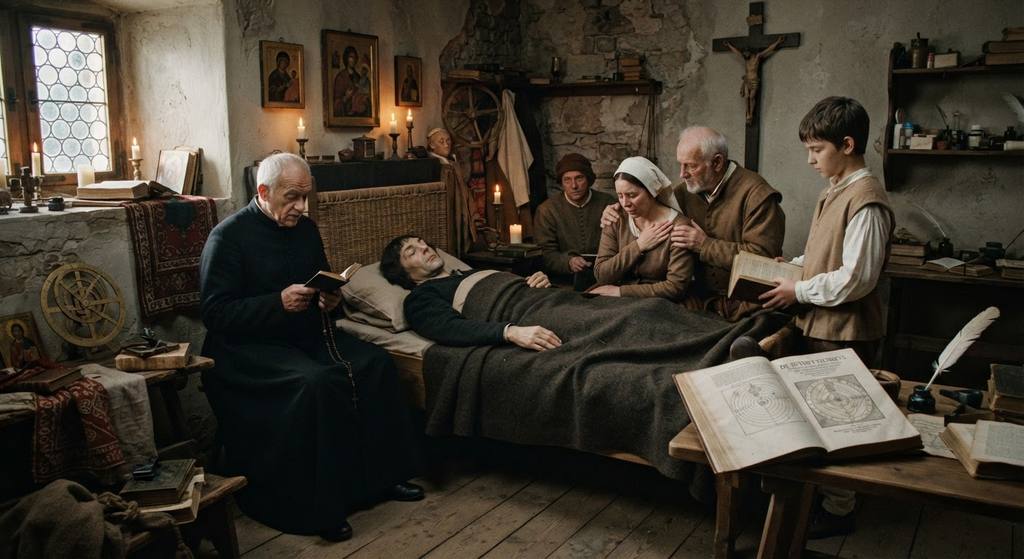
Publication & Death, 1543
Receives the printed De revolutionibus on his deathbed in Frombork Cathedral tower.
CELESTIAL MECHANICS
Five Structural Breakthroughs That Reordered the Cosmos
By replacing Ptolemaic equants with symmetrical geometry, Copernicus did far more than move the Earth. He eliminated arbitrary mathematical hacks, reordered the known planets by orbital speed, and established an elegant, unified physics of celestial motion that transformed human perspective forever.
 I
IThe Elimination of the Equant
Restoring uniform circular motion to the heavens
Restoring celestial motion
 II
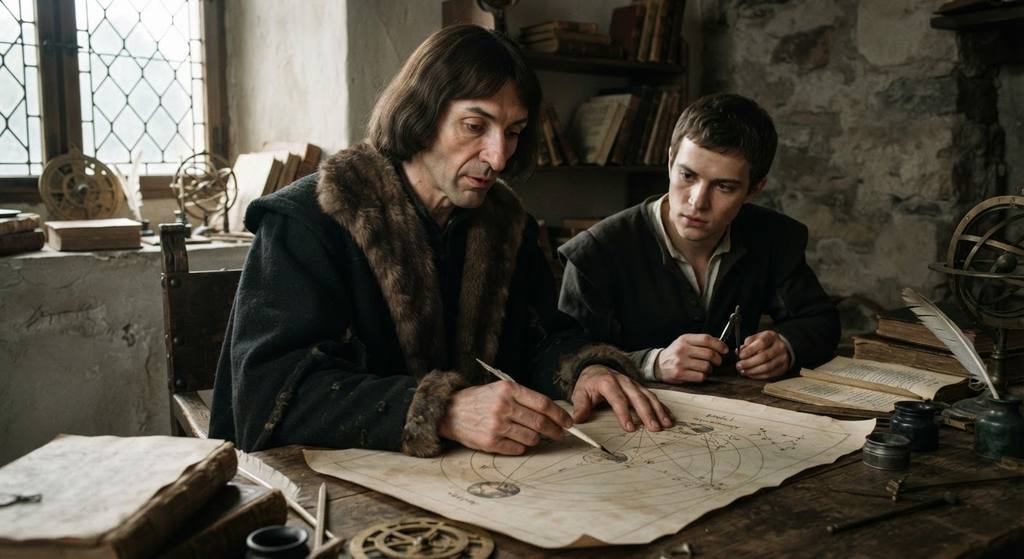
IIThe Orbital Period-Distance Relationship
Establishing a physical logic for planetary spacing
Calculating planetary logic
 III
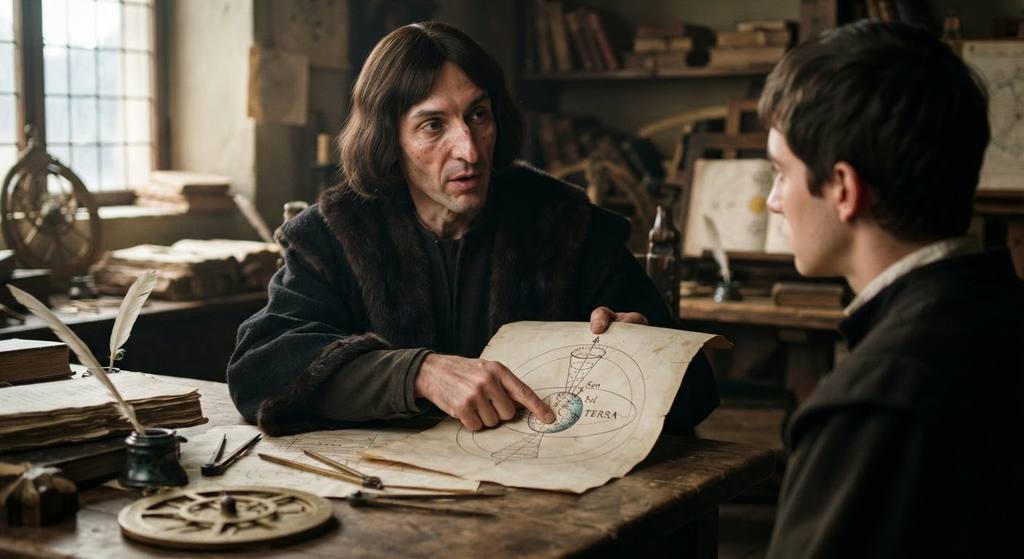
IIIRetrograde Motion as Optical Perspective
Transforming celestial anomalies into geometric necessity
Geometric necessity
 IV
IVThe Threefold Motion of the Earth
Attributing rotation, revolution, and axial precession to our world
Earth's rotation and orbit
 V
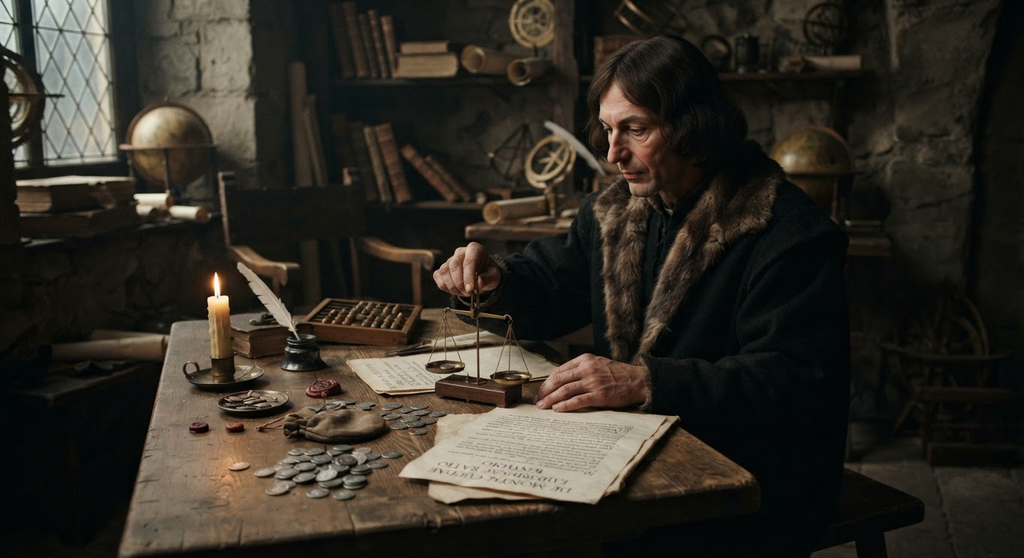
VMonetary Debasement and Currency Laws
Formulating early economic principles to protect public welfare
Economic principles
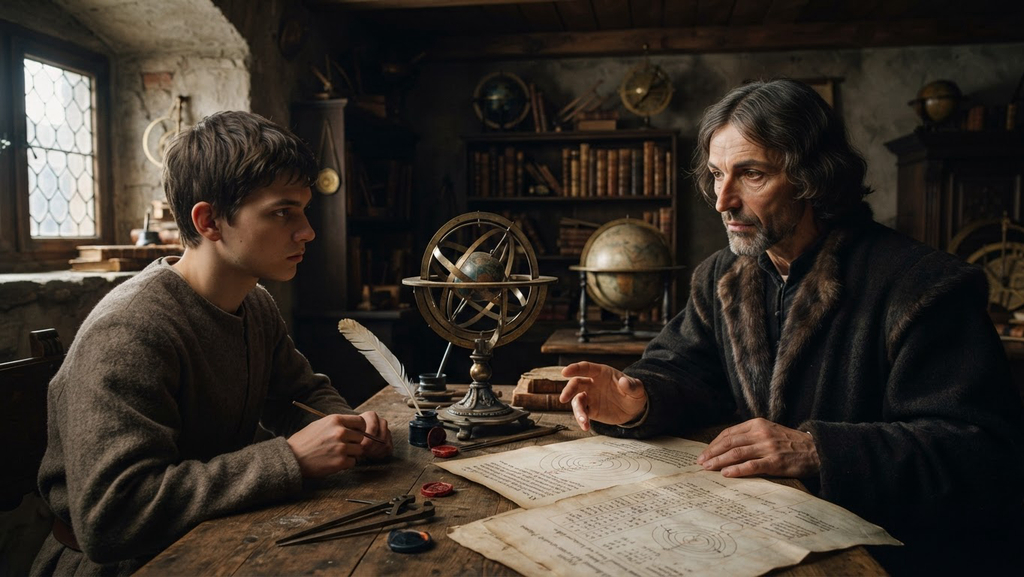
The Elimination of the Equant
Claudio Ptolemy introduced the equant point to reconcile observed planetary speeds with circular paths, but this forced celestial motions to be non-uniform around their true geometric centers. Copernicus rejected this mathematical compromise as physically impossible, developing nested epicycles using the Tusi couple to preserve true uniform circular motion.
Why it matters today: Compromising core principles to solve immediate anomalies often creates fragile, overly complex systems.
“Why did Ptolemy's equant bother you so much, and how did your geometry resolve it?”
What can you ask Nicolaus?
Astronomy & Cosmos
Strategy & Timing
Economics & Society
Try a live answer from Nicolaus
Ask right here — no signup needed. The answer is generated live.
Live answer from Nicolaus Copernicus — no login needed for your first question.
Nicolaus Copernicus quotes — in his own words
12 of the lines Nicolaus is remembered for, with the source for each one. Pick any quote and ask him what he actually meant by it.
Scroll sideways for more · Sources shown per quote; a few widely circulated lines are marked as attributed rather than verbatim.
Why Xminds is different
Related minds around Nicolaus
No one thinks alone. These are the people who supported Nicolaus — and the ones who pushed back. Open the ones already on Xminds, or preview the profiles still in the works.
Friendly minds
Teachers, family, students and allies who shaped Nicolaus.
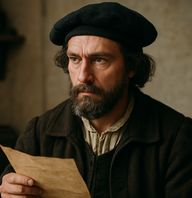
He was Copernicus's only formal pupil, encouraging him to publish his masterwork and overseeing its early printing.
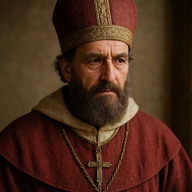
He was a close friend and fellow cleric who spent years persuading Copernicus to release his astronomical findings.
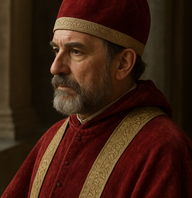
He warmly received a presentation on the Copernican heliocentric system at the Vatican in 1533.

He was a trusted scholarly friend who helped disseminate Copernicus's early astronomical manuscripts.
Opponents
Rivals, accusers and adversaries who tested Nicolaus.

He inserted an anonymous, unauthorized preface into Copernicus's book stating that heliocentrism was just a mathematical model rather than physical truth.

He rejected the heliocentric concept in conversation, referring to Copernicus as an upstart who wished to turn astronomy upside down.
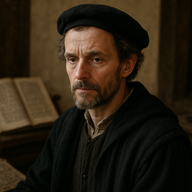
He publicly criticized the moving Earth theory as absurd and contrary to traditional natural philosophy.
What people say about Nicolaus
Ratings are collected right after a conversation ends. Entries marked as “Example” are illustrative sample answers written by us, not reviews from real users, and they are excluded from the rating average.
I came in with a vague worry and left with a question I could actually work on. It never lectured me — it kept asking until I heard my own answer.
Illustrative example
Ten minutes before a difficult meeting I talked it through here. Calmer, sharper, and the advice held up in the room.
Illustrative example
The voice call feels surprisingly natural. Occasionally a bit long-winded, but the substance is genuinely good.
Illustrative example
What I like most is that it stays in character and quotes real sources. It feels like reading with a patient tutor.
Illustrative example
I use it a few evenings a week to think out loud. It has quietly become part of how I make decisions.
Illustrative example
Better than I expected. I wish it remembered more from older conversations, but the depth of each session is excellent.
Illustrative example
Questions & answers
Was Nicolaus Copernicus ever tried or executed by the Catholic Church?
No, Nicolaus Copernicus was never tried or executed. He lived a respected life as a cathedral canon in Warmia and died peacefully in 1543 after receiving the first printed copy of his major astronomical work.
Did Nicolaus Copernicus discover that planetary orbits are elliptical?
No, Nicolaus Copernicus maintained that planetary orbits were perfectly circular. It was Johannes Kepler, working decades later, who mathematically demonstrated that planetary orbits actually follow elliptical paths around the Sun.
Was Nicolaus Copernicus an ordained Catholic priest?
Historical records confirm that Nicolaus Copernicus took minor holy orders and served as a cathedral canon in Warmia, but there is no surviving evidence that he was ever ordained as a Catholic priest.
Why did Nicolaus Copernicus delay publishing his book for so long?
Nicolaus Copernicus hesitated because he wanted complete mathematical accuracy and feared ridicule from scholars attached to Ptolemaic traditions, waiting until his young disciple Rheticus urged publication late in his life.
What other fields did Nicolaus Copernicus contribute to besides astronomy?
Besides astronomy, Nicolaus Copernicus made key contributions to monetary theory by formulating early principles of currency debasement and inflation, while actively practicing medicine and managing church estates in Warmia.
Can I really chat with Nicolaus Copernicus?
Yes. Xminds lets you chat with Nicolaus Copernicus as an AI mentor: the Nicolaus Copernicus AI is built from documented writings, speeches and biography, so you can ask Nicolaus Copernicus anything and get an answer in character rather than a search-results page. The first messages are free and no download is needed.
Can I call Nicolaus Copernicus and talk by voice?
You can. Press the call button to talk to Nicolaus Copernicus in a live voice conversation — the Nicolaus Copernicus AI voice replies in real time, and you can interrupt, follow up and switch language mid-call. Prefer typing? The same conversation works as text chat.
Is the Nicolaus Copernicus chatbot free?
Starting is free: every visitor gets a free daily allowance of messages and voice minutes with the Nicolaus Copernicus AI chatbot. Xminds Pro raises the limits for people who talk to their mentors every day.
How accurate is this Nicolaus Copernicus AI?
Nicolaus Copernicus is a respectful AI portrayal, not the real person and not a channel to them. Answers are grounded in the historical record and cited sources, and every conversation is clearly labelled as AI so you always know who you are talking to.
What should I ask Nicolaus Copernicus about?
Bring a real situation. People come for advice from Nicolaus Copernicus on the themes above, or treat it as an interview with Nicolaus Copernicus about a decision they are facing. You can speak to Nicolaus Copernicus about work, doubt or craft, and meet Nicolaus Copernicus again tomorrow to continue the same thread — it is a conversation, not a Nicolaus Copernicus simulator that repeats stock lines.
Also known as
Nicolaus Copernicus appears under several names and spellings across languages and sources. You can search for any of these on Xminds:
- Mikołaj Kopernik
- Nicolaus Copernicus Torinensis
- Niklas Koppernigk
Reorder your perspective on the cosmos.
Step into the Frombork tower and speak directly with Nicolaus Copernicus.
10 free messages a day • no signup needed

Talk to Nicolaus
10 free messages a day • no signup needed