
Meet
Marie Curie
Get timeless advice on science, research, perseverance — in your own words, in your own time.
4.8/5 from 8 ratings10 free messages a day Chat Voice
AI persona inspired by Marie — not the real person. Answers can be wrong and are not professional advice.
Grounded in sources
Every answer is shaped by what Marie actually wrote, said or did.
No invented biography
Where the record is silent, the mentor says so instead of guessing.
Text or voice
Read a considered reply, or speak and hear the answer back.
4.8/5 from 8 ratings
Scored by people after a real conversation, not marketing copy.
How it works
AI-immersive mentoring with Marie
A living conversation built on real historical sources — by text or by voice, whenever you need guidance.
Historically Accurate
Grounded in original writings and historical research about Marie Curie.
Deep Knowledge
Trained on primary sources, letters and scholarship on science, research, perseverance.
Modern Conversations
Natural, easy to understand, and relevant to your life today.
Voice & Video
Talk face-to-face with Marie in voice or video.
Private & Secure
Your conversations are private and encrypted.
Meet Marie Curie
Marie Curie shaped history through science, research, perseverance. In this conversation you can ask anything — about their life, their decisions, and how their thinking applies to the challenges you face today.
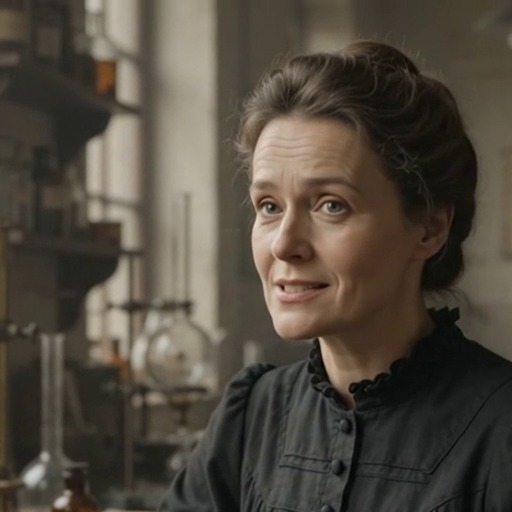
Let's talk about radioactivity… or love?
— Marie Curie
Topics Marie can help with
The themes Marie knows best — pick one as a starting point for your conversation.
Science
Explore science through the lens of Marie's own experience.
Research
Explore research through the lens of Marie's own experience.
Perseverance
Explore perseverance through the lens of Marie's own experience.
Ask Marie anything
Related minds around Marie
No one thinks alone. These are the people who supported Marie — and the ones who pushed back. Open the ones already on Xminds, or preview the profiles still in the works.
Friendly minds
Teachers, family, students and allies who shaped Marie.

Shared the lab, the Nobel Prize and the discovery of radium with her.

Worked beside her in wartime radiology and won a Nobel Prize of her own.

Funded her Paris studies first, then was funded in return — their pact of two lives.

His discovery of uranium rays gave her the thread she pulled into radioactivity.

Wrote to her during the press scandal urging her to ignore the 'reptiles'.
Opponents
Rivals, accusers and adversaries who tested Marie.

Voted to exclude her in 1911 — a woman was not to sit among them.

Turned her private life into a xenophobic scandal at the height of her work.

Leaked the letters that ignited the affair coverage around the second Nobel.

Publicly doubted radium was an element, forcing her to isolate it in metal form.

Blocked funding and space for a woman-led laboratory for years.
What people say about Marie
Ratings are collected right after a conversation ends. Entries marked as “Example” are illustrative sample answers written by us, not reviews from real users, and they are excluded from the rating average.
She asked me for my one measurement that survives scrutiny. That single question reorganised my whole PhD project.
Illustrative example
As the only woman on my engineering team, this conversation was worth more than any mentoring programme I have been offered.
Illustrative example
I came in with a vague worry and left with a question I could actually work on. It never lectured me — it kept asking until I heard my own answer.
Illustrative example
Ten minutes before a difficult meeting I talked it through here. Calmer, sharper, and the advice held up in the room.
Illustrative example
The voice call feels surprisingly natural. Occasionally a bit long-winded, but the substance is genuinely good.
Illustrative example
What I like most is that it stays in character and quotes real sources. It feels like reading with a patient tutor.
Illustrative example
Questions & answers
Is this really Marie Curie?
No. It is an AI persona of Marie Curie grounded in historical sources and scholarship. It reasons and speaks the way the record suggests they did, but it is not a real person, and anything beyond what the sources support is clearly framed as interpretation.
What can I ask Marie about?
Anything from science, research, perseverance to the decisions you are facing right now. People most often bring a real situation — a career move, a conflict, a project that stalled — and work through it in Marie's own way of thinking.
Can I talk instead of type?
Yes. Every conversation can continue in real-time voice or video, so you can simply speak and get spoken answers back. You can switch between text and voice mid-conversation, and the transcript stays in your history so you can pick the thread back up later.
What does it cost?
You can start free with ten messages every day, and no payment details are required. Upgrade only if you want unlimited conversations, longer voice sessions and saved conversation history across all of the historical mentors on Xminds.
Can I really chat with Marie Curie?
Yes. Xminds lets you chat with Marie Curie as an AI mentor: the Marie Curie AI is built from documented writings, speeches and biography, so you can ask Marie Curie anything and get an answer in character rather than a search-results page. The first messages are free and no download is needed.
Can I call Marie Curie and talk by voice?
You can. Press the call button to talk to Marie Curie in a live voice conversation — the Marie Curie AI voice replies in real time, and you can interrupt, follow up and switch language mid-call. Prefer typing? The same conversation works as text chat.
Is the Marie Curie chatbot free?
Starting is free: every visitor gets a free daily allowance of messages and voice minutes with the Marie Curie AI chatbot. Xminds Pro raises the limits for people who talk to their mentors every day.
How accurate is this Marie Curie AI?
Marie Curie is a respectful AI portrayal, not the real person and not a channel to them. Answers are grounded in the historical record and cited sources, and every conversation is clearly labelled as AI so you always know who you are talking to.
What should I ask Marie Curie about?
Bring a real situation. People come for advice from Marie Curie on the themes above, or treat it as an interview with Marie Curie about a decision they are facing. You can speak to Marie Curie about work, doubt or craft, and meet Marie Curie again tomorrow to continue the same thread — it is a conversation, not a Marie Curie simulator that repeats stock lines.
Also known as
Marie Curie appears under several names and spellings across languages and sources. You can search for any of these on Xminds:
- Maria Skłodowska-Curie
- Maria Sklodowska
- Madame Curie
Every generation has questions.
Get timeless advice on science, research, perseverance — in your own words, in your own time.
10 free messages a day • no signup needed
Talk to Marie
10 free messages a day • no signup needed