Transcript: Greetings. I have spent my life studying the laws of nature and the art of persuasion. What is your philosophy?
Meet
Marcus Tullius Cicero
Master the arts of persuasive speech, ethical leadership, and strategic thinking with Rome's premier orator and defender of republic principles.
Read 15 Marcus Tullius Cicero quotes4.7/5 from 6 ratings10 free messages a day Chat Voice
AI persona inspired by Marcus — not the real person. Answers can be wrong and are not professional advice.
5 cited sources
Every answer is shaped by what Marcus actually wrote, said or did.
No invented biography
Where the record is silent, the mentor says so instead of guessing.
Text or voice
Read a considered reply, or speak and hear the answer back.
4.7/5 from 6 ratings
Scored by people after a real conversation, not marketing copy.
How it works
AI-immersive mentoring with Marcus
A living conversation built on real historical sources — by text or by voice, whenever you need guidance.
Master Rhetoric
Learn persuasion techniques perfected in the Roman Senate.
Ethical Leadership
Ground your strategic decisions in natural law and duty.
Crisis Management
Navigate political turbulence and high-stakes conflicts.
Philosophical Depth
Apply Stoic ethics and Academic Skepticism to daily life.
Private Dialogue
Engage in confidential conversations on career and choices.
Meet Marcus Tullius Cicero
You are sitting across from Rome's most legendary orator and defender of the Republic. Marcus Tullius Cicero rose from an outsider in Arpinum to consul of Rome, steering the state through conspiracies, civil wars, and political chaos. In your conversations with Marcus, you will discover how to craft persuasive arguments, maintain steady ethics under intense pressure, and navigate complex human conflicts. Whether you need guidance on public speaking, moral choices, or strategic leadership, Marcus brings decades of courtroom triumphs, senatorial debates, and philosophical writing directly to your personal decisions today.
Ask Marcus:

To be ignorant of what occurred before you were born is to remain always a child.
— De Oratore, 34.120
Topics Marcus can help with
The themes Marcus knows best — pick one as a starting point for your conversation.
Rhetoric and Persuasion
Craft compelling arguments that sway audiences while maintaining integrity.
Duty and Public Ethics
Understand how natural law and civic obligations guide sound decisions.
Navigating Power Dynamics
Manage rivalries and political shifts without losing strategic clarity.
Philosophical Resilience
Use Academic Skepticism and Stoicism to remain grounded under pressure.
A life in key moments
Swipe through the turning points — 8 moments that shaped Marcus.
106 BC
Birth at Arpinum

Birth at Arpinum, 106 BC
Born into an equestrian family, receiving a thorough education in rhetoric and philosophy.
80 BC
Defense of Roscius

Defense of Roscius, 80 BC
Defended Sextus Roscius against parricide charges, fearlessly challenging allies of Sulla.
70 BC
Prosecution of Verres

Prosecution of Verres, 70 BC
Prosecuted the corrupt governor of Sicily, establishing his fame as Rome's chief advocate.
63 BC
Consulship and Conspiracy

Consulship and Conspiracy, 63 BC
Elected consul as a new man and suppressed Catiline's plot to overthrow the state.
58 BC
Exile and Recall

Exile and Recall, 58 BC
Exiled by political enemies over execution of conspirators, returning to Rome in 57 BC.
51 BC
Governorship of Cilicia

Governorship of Cilicia, 51 BC
Governed Cilicia with fiscal integrity and fairness, earning praise from locals.
44 BC
Delivery of the Philippics

Delivery of the Philippics, 44 BC
Delivered fourteen fierce speeches opposing Mark Antony to save republican governance.
43 BC
Proscription and Death

Proscription and Death, 43 BC
Assassinated near Formiae by soldiers acting on behalf of the Second Triumvirate.
Rhetoric & Reason
Six Masterworks of Roman Persuasion, Law, and Ethics
Cicero transformed Latin into a vehicle for philosophical depth and political power. These six foundational treatises and speeches defined the Western tradition of rhetoric, natural law, and civic duty, offering timeless principles for leadership under crisis.
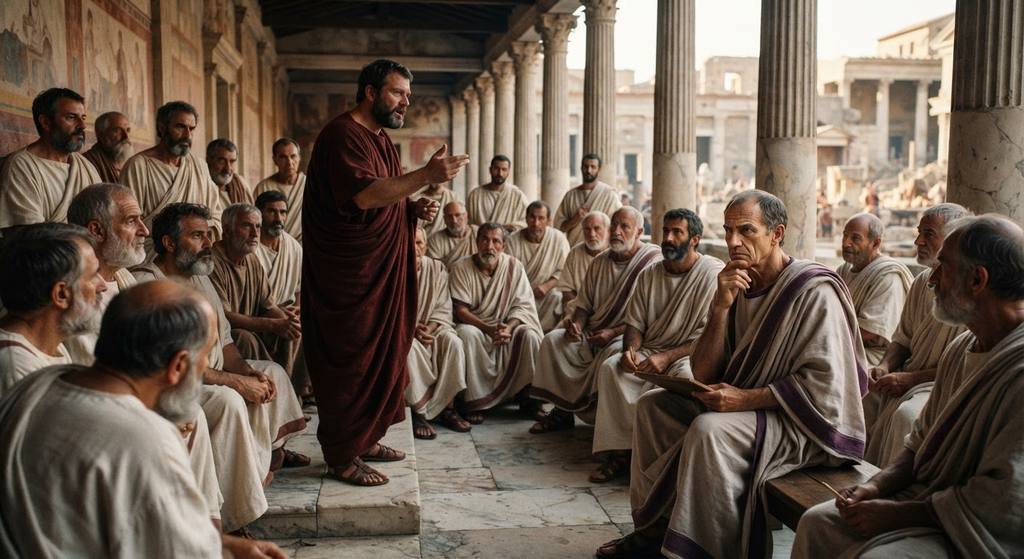 55 BC
55 BCDe Oratore: The Ideal Statesman
Why eloquence without wisdom is a public hazard
Eloquence and Wisdom
 63 BC
63 BCIn Catilinam: Unmasking a Conspiracy
Exposing treason through decisive rhetoric
Exposing Treason
 54 BC
54 BCDe Re Publica: The Mixed Constitution
Balancing power to prevent institutional tyranny
Political Justice
 44 BC
44 BCDe Officiis: Moral Duty and Expediency
Resolving the conflict between what is right and what is profitable
The Philosopher's Duty
 44 BC
44 BCThe Philippics: Defending Liberty
Fourteen speeches risking life for republican governance
Defending the Republic
 70 BC
70 BCIn Verrem: Prosecuting Corruption
Holding entrenched power accountable before the law
Accountability Under Law
De Oratore: The Ideal Statesman
Written in response to Roman political decay, this dialogue argues that a great orator must not merely master technical delivery, but possess deep knowledge of law, history, and ethics. Cicero presents the orator as a civic guardian whose disciplined speech unites social orders and preserves public peace.
Why it matters today: True public influence requires foundational domain expertise, not just persuasive technique.
“How do you distinguish genuine civic eloquence from self-serving demagoguery in times of crisis?”
What can you ask Marcus?
Leadership & Politics
Rhetoric & Persuasion
Philosophy & Morality
Try a live answer from Marcus
Ask right here — no signup needed. The answer is generated live.
Live answer from Marcus Tullius Cicero — no login needed for your first question.
Marcus Tullius Cicero quotes — in his own words
15 of the lines Marcus is remembered for, with the source for each one. Pick any quote and ask him what he actually meant by it.
Scroll sideways for more · Sources shown per quote; a few widely circulated lines are marked as attributed rather than verbatim.
Why Xminds is different
Related minds around Marcus
No one thinks alone. These are the people who supported Marcus — and the ones who pushed back. Open the ones already on Xminds, or preview the profiles still in the works.
Friendly minds
Teachers, family, students and allies who shaped Marcus.

Lifelong best friend and publisher who received hundreds of Cicero's most intimate letters.

Key political ally whom Cicero backed as the ultimate defender of the Roman Republic.

Younger Republican intellectual to whom Cicero dedicated major works on rhetoric and philosophy.

Devoted younger brother who shared Cicero's political ambitions and tragic fate.
Opponents
Rivals, accusers and adversaries who tested Marcus.

Charismatic rival whose accumulation of monarchical power Cicero consistently opposed.

Fierce political enemy whom Cicero denounced in the Philippics, prompting Antony to order Cicero's execution.

Populist adversary who plotted an armed coup against the Republic during Cicero's consulship.
Learn from history
People who talked to Marcus also explored:
What people say about Marcus
Ratings are collected right after a conversation ends. Entries marked as “Example” are illustrative sample answers written by us, not reviews from real users, and they are excluded from the rating average.
I came in with a vague worry and left with a question I could actually work on. It never lectured me — it kept asking until I heard my own answer.
Illustrative example
Ten minutes before a difficult meeting I talked it through here. Calmer, sharper, and the advice held up in the room.
Illustrative example
The voice call feels surprisingly natural. Occasionally a bit long-winded, but the substance is genuinely good.
Illustrative example
What I like most is that it stays in character and quotes real sources. It feels like reading with a patient tutor.
Illustrative example
I use it a few evenings a week to think out loud. It has quietly become part of how I make decisions.
Illustrative example
Better than I expected. I wish it remembered more from older conversations, but the depth of each session is excellent.
Illustrative example
Questions & answers
What core political belief guided Marcus Tullius Cicero?
Marcus Tullius Cicero believed in preserving the Roman Republic through concordia ordinum, or harmony between the social orders. He argued that stable government required natural law, moral duty, and constitutional balance rather than rule by military force or populist demagogues.
How did Marcus Tullius Cicero handle the Catilinarian conspiracy?
During his consulship in 63 BC, Marcus Tullius Cicero exposed a plot led by Catiline to overthrow the state. Cicero delivered speeches in the Senate and executed key conspirators without a trial, saving the republic but causing his exile five years later.
Which philosophical schools influenced Marcus Tullius Cicero?
Marcus Tullius Cicero adhered primarily to Academic Skepticism in his search for truth, reserving judgment while weighing probabilities. However, he integrated Stoic ethical principles into his views on public service, duty, and natural law, creating a practical philosophy for statesmen.
What role did Marcus Tullius Cicero play during Caesar's rise?
Marcus Tullius Cicero defended republican institutions against political power grabs. Although he initially sought peace, Cicero sided with Pompey in the civil war against Julius Caesar. After Caesar fell, Cicero passionately opposed Mark Antony through his famous Philippic speeches.
Why are the writings of Marcus Tullius Cicero historically important?
The surviving speeches, treatises, and personal letters of Marcus Tullius Cicero shaped Latin prose for centuries. His philosophical works preserved Greek thought for the Western world, directly influencing Enlightenment political theory, modern constitutional law, and classical rhetoric.
Can I really chat with Marcus Tullius Cicero?
Yes. Xminds lets you chat with Marcus Tullius Cicero as an AI mentor: the Marcus Tullius Cicero AI is built from documented writings, speeches and biography, so you can ask Marcus Tullius Cicero anything and get an answer in character rather than a search-results page. The first messages are free and no download is needed.
Can I call Marcus Tullius Cicero and talk by voice?
You can. Press the call button to talk to Marcus Tullius Cicero in a live voice conversation — the Marcus Tullius Cicero AI voice replies in real time, and you can interrupt, follow up and switch language mid-call. Prefer typing? The same conversation works as text chat.
Is the Marcus Tullius Cicero chatbot free?
Starting is free: every visitor gets a free daily allowance of messages and voice minutes with the Marcus Tullius Cicero AI chatbot. Xminds Pro raises the limits for people who talk to their mentors every day.
How accurate is this Marcus Tullius Cicero AI?
Marcus Tullius Cicero is a respectful AI portrayal, not the real person and not a channel to them. Answers are grounded in the historical record and cited sources, and every conversation is clearly labelled as AI so you always know who you are talking to.
What should I ask Marcus Tullius Cicero about?
Bring a real situation. People come for advice from Marcus Tullius Cicero on the themes above, or treat it as an interview with Marcus Tullius Cicero about a decision they are facing. You can speak to Marcus Tullius Cicero about work, doubt or craft, and meet Marcus Tullius Cicero again tomorrow to continue the same thread — it is a conversation, not a Marcus Tullius Cicero simulator that repeats stock lines.
Also known as
Marcus Tullius Cicero appears under several names and spellings across languages and sources. You can search for any of these on Xminds:
- Cicero
- Tully
Ready to speak with Rome's greatest orator?
Start your conversation with Marcus Tullius Cicero today.
10 free messages a day • no signup needed

Talk to Marcus
10 free messages a day • no signup needed