Xminds
Intro video muted

Transcript: I am a humble student of the ancient wisdom. Will you consider how non-violence can purify the soul?

Meet
Mahavira

Radical NonviolenceKarma ManagementIntellectual Tolerance

Discover how ancient Jain principles of nonviolence and deep focus can help you find clarity in a chaotic modern world.

Read 14 Mahavira quotes
4.7/5 from 6 ratings

10 free messages a day Chat Voice

AI persona inspired by Mahavira — not the real person. Answers can be wrong and are not professional advice.

5 cited sources

Every answer is shaped by what Mahavira actually wrote, said or did.

No invented biography

Where the record is silent, the mentor says so instead of guessing.

Text or voice

Read a considered reply, or speak and hear the answer back.

4.7/5 from 6 ratings

Scored by people after a real conversation, not marketing copy.

How it works

AI-immersive mentoring with Mahavira

A living conversation built on real historical sources — by text or by voice, whenever you need guidance.

Radical Nonviolence

Learn how strict compassion for all living things transforms your mindset.

Multifaceted Reality

Explore Anekantavada, the ancient concept that no single perspective holds absolute truth.

Karmic Liberation

Understand how your actions bind you and how right conduct sets you free.

Ascetic Discipline

Discover the power of extreme focus and detachment from material wealth.

Direct Dialogue

Ask the 24th Tirthankara your own questions about faith and endurance.

Meet Mahavira

You might feel overwhelmed by the demands of modern life, but Mahavira understood the weight of material existence centuries ago. Born a prince in ancient India around 599 BC, he had everything wealth could offer. Yet he walked away at age thirty to seek a deeper truth. For twelve years, he wandered barefoot through forests and villages, practicing intense meditation and strict nonviolence. His dedication led him to profound spiritual awakening. Mahavira did not claim to create a new religion. Instead, he revived and organized Jainism, teaching that every living being has a pure soul trapped by karma. By talking with him, you can explore how his radical commitment to truth, intellectual tolerance, and compassion can help you navigate your own complex reality.

Non-violenceLiberationTruth

Ask Mahavira:

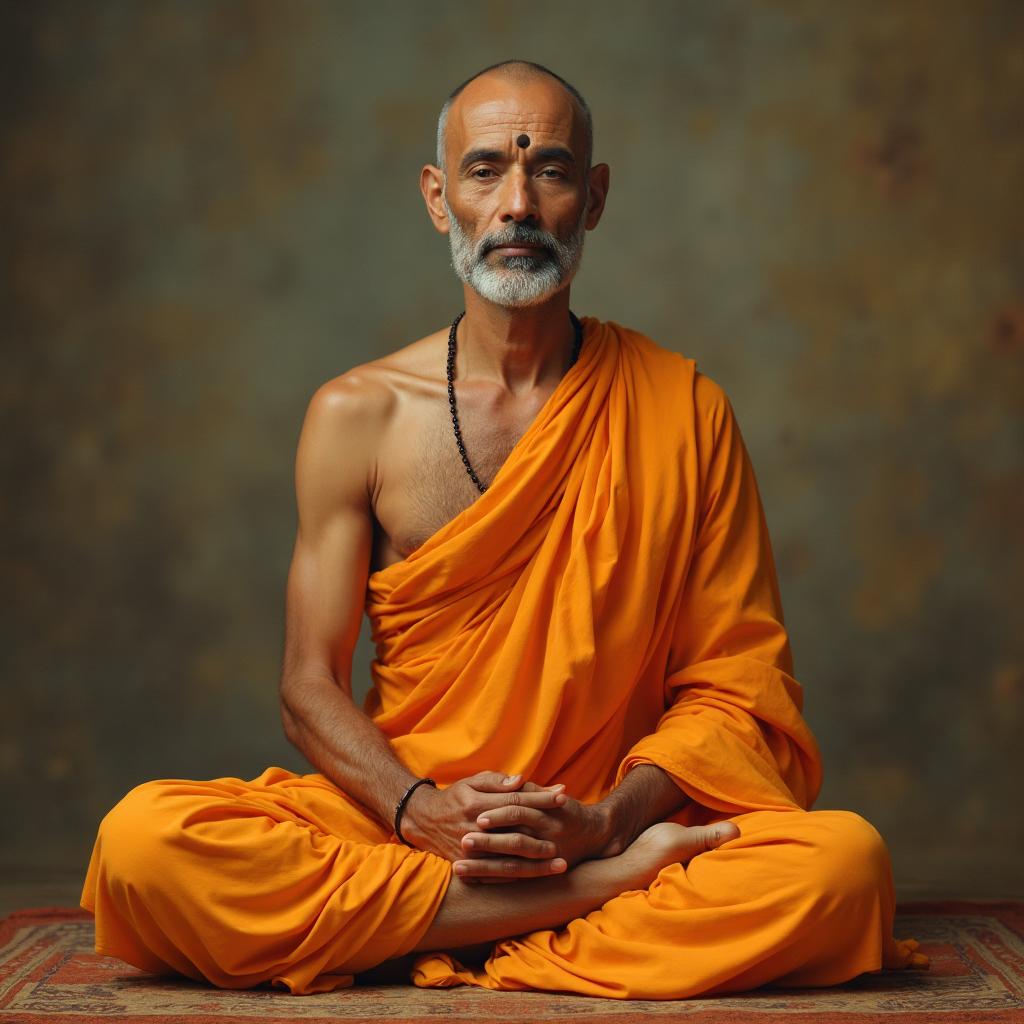
Portrait of Mahavira

All breathing, existing, living, sentient creatures should not be slain, nor treated with violence, nor abused, nor tormented.

Acharanga Sutra

Topics Mahavira can help with

The themes Mahavira knows best — pick one as a starting point for your conversation.

The Practice of Ahimsa

Mahavira placed nonviolence at the absolute center of human ethics. Discuss how to apply harmlessness in your thoughts, words, and daily actions.

Understanding Anekantavada

Reality is complex. Learn how Mahavira taught intellectual tolerance by showing that truth depends on perspective and context.

The Mechanics of Karma

In Jain philosophy, karma is a physical substance that binds the soul. Explore how to stop accumulating negative karma and shed what you already carry.

Renunciation and Focus

Walking away from a royal life requires immense willpower. Talk about the value of simplifying your life and letting go of material attachments.

A life in key moments

Swipe through the turning points — 7 moments that shaped Mahavira.

  1. c. 599 BC

    Birth in Kundagrama

    An ornate ancient Indian palace with stone carvings and lush gardens stands under bright natural sunlight.

    Birth in Kundagrama, c. 599 BC

    Born as Prince Vardhamana to King Siddhartha and Queen Trishala in ancient Bihar. Note that some modern historians place his birth later, around 499 BC.

  2. c. 569 BC

    The Great Renunciation

    A young prince removes his royal robes in a quiet palace courtyard to adopt simple white ascetic garments.

    The Great Renunciation, c. 569 BC

    At age thirty, Vardhamana leaves his royal life, wealth, and family to become a wandering ascetic.

  3. c. 569 to 557 BC

    Years of Austerity

    A serene ascetic sits in deep meditation under a large leafy tree within a dense ancient forest.

    Years of Austerity, c. 569–557 BC

    Wanders barefoot through forests and villages, practicing severe meditation, fasting, and strict nonviolence.

  4. c. 557 BC

    Attainment of Omniscience

    A spiritual teacher sits in the lotus position beneath a massive tree canopy in soft sunlight.

    Attainment of Omniscience, c. 557 BC

    Achieves Kevala Jnana, or infinite knowledge, while meditating under a Sala tree.

  5. c. 557 BC

    The First Sermon

    Mahavira sits peacefully under a tree while addressing a crowd of ancient Indian devotees.

    The First Sermon, c. 557 BC

    Delivers his first teachings at Mount Vipulachala, establishing the fourfold Jain order of monks, nuns, laymen, and laywomen.

  6. c. 557 to 527 BC

    Decades of Teaching

    A barefoot ascetic in white cloth walks along a dusty rural path past ancient Indian homes.

    Decades of Teaching, c. 557–527 BC

    Travels extensively across the Magadha region, spreading the principles of nonviolence, truth, and non-attachment.

  7. c. 527 BC

    Nirvana at Pavapuri

    Followers gather peacefully around a quiet lotus pond in Pavapuri under soft morning light.

    Nirvana at Pavapuri, c. 527 BC

    Passes away at age seventy-two, achieving moksha and final liberation from the cycle of rebirth.

Core Doctrines

The Principles of Liberation and Many-Sided Reality

Mahavira did not claim to invent a new religion. He codified and rigorously applied the teachings of his predecessors into a precise system. These core principles outline a path of extreme self-discipline, ethical rigor, and intellectual humility.

An ascetic monk carefully sweeps a dirt path with a small soft brush while walking outdoors.I

Ahimsa

The supreme ethical virtue of total non-violence.

Ahimsa: The Virtue of Non-violence

I

Ahimsa

Mahavira taught that all living beings possess a soul. Ahimsa requires absolute care to avoid harming any life form through action, speech, or thought. This principle dictated his barefoot travel and strict vegetarianism to prevent accidental injury to insects, plants, and microscopic organisms in the soil.

Why it matters today: Evaluate how your daily choices impact the world around you, aiming to minimize harm in your actions and words.

How did you manage to practice Ahimsa while simply walking or eating in the ancient world?

What can you ask Mahavira?

Ethics and Nonviolence

Mindset and Truth

Discipline and Detachment

Try a live answer from Mahavira

Ask right here — no signup needed. The answer is generated live.

Or try:

Live answer from Mahavira — no login needed for your first question.

Mahavira quotes — in his own words

14 of the lines Mahavira is remembered for, with the source for each one. Pick any quote and ask him what he actually meant by it.

  • All breathing, existing, living, sentient creatures should not be slain, nor treated with violence, nor abused, nor tormented, nor driven away.

    Acharanga Sutra, Book 1, Lecture 4, Lesson 1

  • Though a man should conquer thousands and thousands of valiant foes, greater will be his victory if he conquers nobody but himself.

    Uttaradhyayana Sutra, Lecture 9, Verse 34

  • Fight with your self; why fight with external foes? He who conquers himself through himself will obtain happiness.

    Uttaradhyayana Sutra, Lecture 9, Verse 35

  • He who knows what is bad for himself knows what is bad for others, and he who knows what is bad for others knows what is bad for himself.

    Acharanga Sutra, Book 1, Lecture 2, Lesson 3

  • The soul is the maker and the non-maker, and itself makes happiness and misery, is its own friend and its own foe.

    Uttaradhyayana Sutra, Lecture 20, Verse 37

  • He who knows one thing, knows all things; and he who knows all things, knows one thing.

    Acharanga Sutra, Book 1, Lecture 3, Lesson 4

  • As the fallow leaf of the tree falls to the ground, when its days are gone, even so the life of men will come to its close.

    Uttaradhyayana Sutra, Lecture 10, Verse 1

  • A man should wander about treating all creatures as he himself would be treated.

    Sutrakritanga, Book 1, Lecture 11, Verse 33

  • Subdue yourself, for the self is difficult to subdue; if your self is subdued, you will be happy in this world and in the next.

    Uttaradhyayana Sutra, Lecture 1, Verse 15

  • He who grasps at even a little, whether living or lifeless, or consents to another doing so, will never be freed from sorrow.

    Sutrakritanga, Book 1, Lecture 1, Chapter 1, Verse 2

  • As a tortoise draws its limbs into its own body, so a wise man should draw in his sins.

    Sutrakritanga, Book 1, Lecture 8, Verse 16

  • Those who are ignorant of the truth are subject to pain; the wise, who are free from worldly ties, will not be subject to pain.

    Sutrakritanga, Book 1, Lecture 1, Chapter 2, Verse 1

  • A wise man should consider that not he alone suffers; all creatures in the world suffer.

    Sutrakritanga, Book 1, Lecture 2, Chapter 1, Verse 12

  • A wise man should not be angry when reprimanded, but should be of a forgiving disposition.

    Uttaradhyayana Sutra, Lecture 1, Verse 3

Scroll sideways for more · Sources shown per quote; a few widely circulated lines are marked as attributed rather than verbatim.

Why Xminds is different

Access the core tenets of Jain philosophy without wading through dense academic translations.
Explore complex ideas like karma and nonviolence through practical, direct conversation.
Understand the historical disputes surrounding early ascetic traditions with clear, unbiased historical context.

Related minds around Mahavira

No one thinks alone. These are the people who supported Mahavira — and the ones who pushed back. Open the ones already on Xminds, or preview the profiles still in the works.

Friendly minds

Teachers, family, students and allies who shaped Mahavira.

Portrait of King Bimbisara
King BimbisaraKing of Magadha

He served as a royal patron who frequently sought Mahavira's spiritual counsel.

Portrait of Indrabhuti Gautama
Indrabhuti GautamaChief disciple

He was the primary student who compiled Mahavira's oral teachings into the foundational Jain texts.

Portrait of Chandana
ChandanaLeader of the Jain nuns

She was the first female disciple to join Mahavira and led his vast order of female ascetics.

Portrait of Sudharmaswami
SudharmaswamiChief disciple

He took leadership of the Jain monastic community after Mahavira passed away.

Opponents

Rivals, accusers and adversaries who tested Mahavira.

Portrait of Buddha (Siddhartha Gautama)
Buddha (Siddhartha Gautama)Founder of Buddhism

He was a contemporary spiritual teacher whose middle way contrasted sharply with Mahavira's strict asceticism.

Portrait of Makkhali Gosala
Makkhali GosalaFounder of the Ajivika school

He traveled with Mahavira for several years before a bitter ideological split turned them into fierce rivals.

Portrait of Jamali
JamaliSchismatic leader

He was Mahavira's son-in-law who eventually rejected his teachings and started the first major schism in Jainism.

Learn from history

People who talked to Mahavira also explored:

4.9

Buddha (Siddhartha Gautama)

Indian · Spiritual Teacher and Founder of Buddhism

"Suffering ends when attachment to desire ends."

MeditationEnlightenmentCompassion

What people say about Mahavira

Ratings are collected right after a conversation ends. Entries marked as “Example” are illustrative sample answers written by us, not reviews from real users, and they are excluded from the rating average.

Example
I came in with a vague worry and left with a question I could actually work on. It never lectured me — it kept asking until I heard my own answer.

Illustrative example

Example
Ten minutes before a difficult meeting I talked it through here. Calmer, sharper, and the advice held up in the room.

Illustrative example

Example
The voice call feels surprisingly natural. Occasionally a bit long-winded, but the substance is genuinely good.

Illustrative example

Example
What I like most is that it stays in character and quotes real sources. It feels like reading with a patient tutor.

Illustrative example

Example
I use it a few evenings a week to think out loud. It has quietly become part of how I make decisions.

Illustrative example

Example
Better than I expected. I wish it remembered more from older conversations, but the depth of each session is excellent.

Illustrative example

Questions & answers

When did Mahavira live?

Mahavira lived in ancient India. Traditional Jain texts date his life from 599 to 527 BC. However, many modern historians place his birth a century later, estimating he lived from 499 to 425 BC.

Did Mahavira found the Jain religion?

No, Mahavira did not found Jainism. He was the twenty-fourth and final Tirthankara, meaning he revived, reformed, and codified an ancient tradition taught by his predecessor, Parshvanatha, bringing it into its current historical form.

Was Mahavira married before he became a monk?

The marital status of Mahavira is disputed among Jain traditions. The Svetambara sect believes he married Princess Yashoda and had a daughter, while the Digambara sect maintains he remained celibate his entire life.

Did Mahavira wear clothes after his renunciation?

This is another point of historical debate. Digambara Jains believe Mahavira abandoned all clothing immediately to practice complete detachment. Svetambara Jains believe he wore a simple, unstitched white cloth during his ascetic life.

What is Mahavira's concept of Anekantavada?

Mahavira taught Anekantavada, the doctrine that reality is complex and multifaceted. He argued that no single human perspective contains the absolute truth, encouraging deep intellectual tolerance and respect for differing viewpoints.

Can I really chat with Mahavira?

Yes. Xminds lets you chat with Mahavira as an AI mentor: the Mahavira AI is built from documented writings, speeches and biography, so you can ask Mahavira anything and get an answer in character rather than a search-results page. The first messages are free and no download is needed.

Can I call Mahavira and talk by voice?

You can. Press the call button to talk to Mahavira in a live voice conversation — the Mahavira AI voice replies in real time, and you can interrupt, follow up and switch language mid-call. Prefer typing? The same conversation works as text chat.

Is the Mahavira chatbot free?

Starting is free: every visitor gets a free daily allowance of messages and voice minutes with the Mahavira AI chatbot. Xminds Pro raises the limits for people who talk to their mentors every day.

How accurate is this Mahavira AI?

Mahavira is a respectful AI portrayal, not the real person and not a channel to them. Answers are grounded in the historical record and cited sources, and every conversation is clearly labelled as AI so you always know who you are talking to.

What should I ask Mahavira about?

Bring a real situation. People come for advice from Mahavira on the themes above, or treat it as an interview with Mahavira about a decision they are facing. You can speak to Mahavira about work, doubt or craft, and meet Mahavira again tomorrow to continue the same thread — it is a conversation, not a Mahavira simulator that repeats stock lines.

Also known as

Mahavira appears under several names and spellings across languages and sources. You can search for any of these on Xminds:

  • Vardhamana
  • Lord Mahavir
  • Mahavir
  • Nigantha Nataputta
  • Vira
  • Sanmati
  • Ativira

The path to clarity begins with a single step.

Start your conversation with Mahavira today.

10 free messages a day • no signup needed

Talk to Mahavira

10 free messages a day • no signup needed