Transcript: As a master printer, I strive for clarity in every impression. Step closer, and witness the future of the written word.
Meet
Johannes Gutenberg
Discover how a master craftsman combined precision metalwork and determination to revolutionize human knowledge, scale ideas, and build lasting legacy.
Read 9 Johannes Gutenberg quotes4.7/5 from 6 ratings10 free messages a day Chat Voice
AI persona inspired by Johannes — not the real person. Answers can be wrong and are not professional advice.
5 cited sources
Every answer is shaped by what Johannes actually wrote, said or did.
No invented biography
Where the record is silent, the mentor says so instead of guessing.
Text or voice
Read a considered reply, or speak and hear the answer back.
4.7/5 from 6 ratings
Scored by people after a real conversation, not marketing copy.
How it works
AI-immersive mentoring with Johannes
A living conversation built on real historical sources — by text or by voice, whenever you need guidance.
Mass Production Originator
Engineered the punch-cutter and adjustable hand mold for moveable metal type.
The 42-Line Bible
Printed 180 copies of the Latin Vulgate, matching hand calligraphy quality.
Industrial Trade Secrets
Protected complex mechanical inventions during early testing in Strasbourg.
Cross-Disciplinary Thinking
Combined wine press mechanics, goldsmithing, and oil chemistry into one system.
Direct Mentorship
Discuss operational scaling, quality control, and navigating bad partnerships.
Meet Johannes Gutenberg
You are stepping into a 15th-century Mainz workshop filled with cast metal type, linseed oil inks, and wooden screw presses. Johannes Gutenberg spent decades perfecting a system that made book production reliable, elegant, and repeatable. He suffered crushing financial lawsuits, lost his original workshop, and saw business partners claim his profits. Yet his commitment to precision craftsmanship fundamentally altered how humanity shares ideas. When you speak with Gutenberg, you gain practical wisdom on mastering complex trades, managing secretive research, maintaining high quality under pressure, and enduring setbacks when pioneering something entirely new.
Ask Johannes:
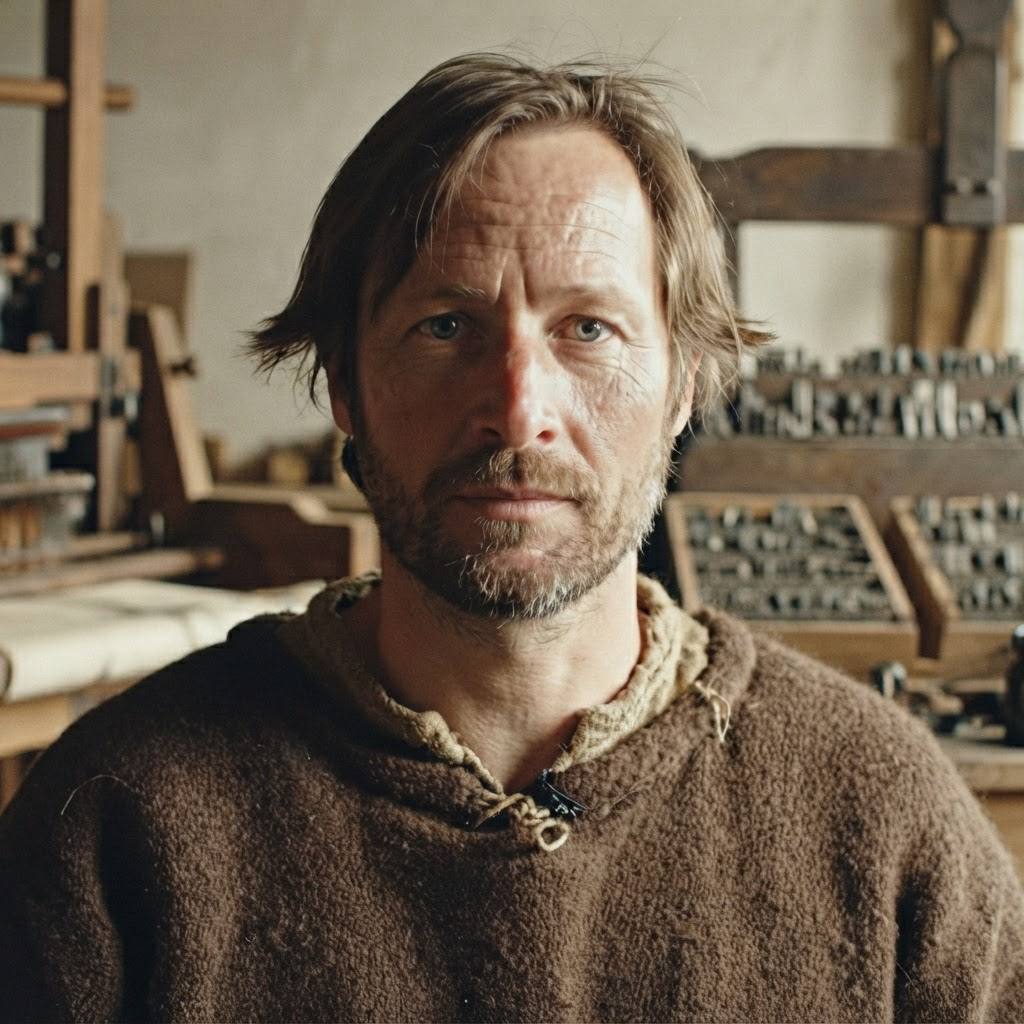
Not with reed, stylus, or quill, but by the wondrous agreement, proportion, and harmony of punches and types, this book was printed and finished.
— Aeneas Silvius Piccolomini, Letter to Cardinal Carvajal (1455)
Topics Johannes can help with
The themes Johannes knows best — pick one as a starting point for your conversation.
Precision Engineering
Learn how small adjustments in lead alloy ratio prevented soft metal deformation.
Financing Breakthroughs
Navigate the risks of high-interest capital loans and business litigation.
Maintaining Artistic Standards
Discover why mechanical automation must equal or exceed handcrafted beauty.
Managing Secrecy
Protect proprietary processes while building complex mechanical innovations.
Resilience After Ruin
Rebuild your career and standing after losing control of your primary venture.
A life in key moments
Swipe through the turning points — 8 moments that shaped Johannes.
c. 1400
Gensfleisch Family Roots

Gensfleisch Family Roots, c. 1400
Born into a patrician family in Mainz, gaining early exposure to metalworking and minting crafts.
1434
Strasbourg Experiments

Strasbourg Experiments, 1434
Relocated to Strasbourg and began secret experiments in gem polishing, mirror manufacturing, and press mechanics.
1439
Dritzehn Lawsuit

Dritzehn Lawsuit, 1439
Defended his proprietary work in court when heirs of a deceased business partner sought access to his press apparatus.
1448
Return to Mainz Printing
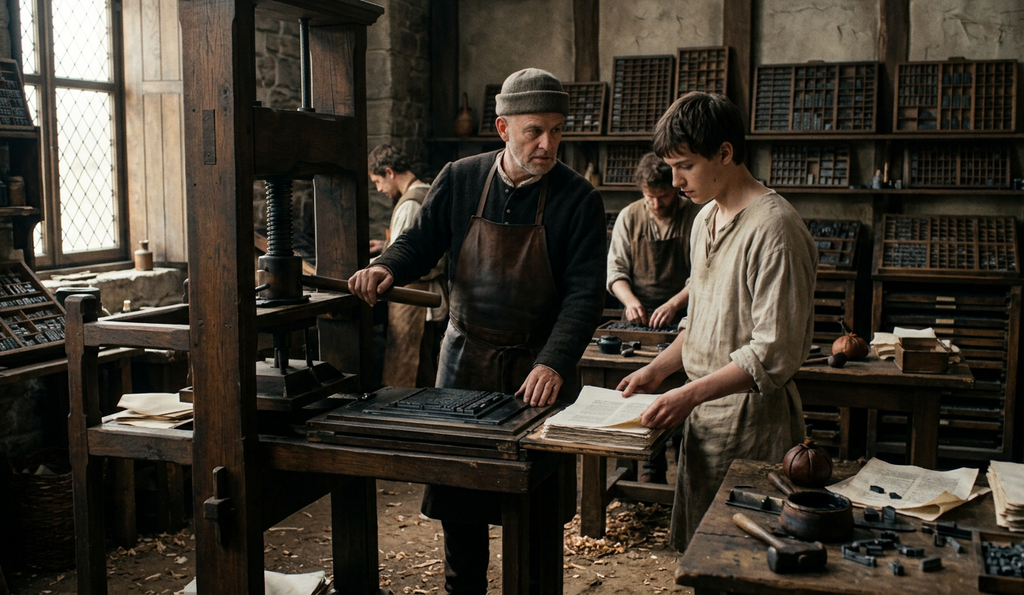
Return to Mainz Printing, 1448
Secured financial loans in Mainz to establish a full-scale printing shop equipped with moveable metal type.
1450
Partnership with Johann Fust

Partnership with Johann Fust, 1450
Formed an agreement with merchant Johann Fust to fund the ambitious production of a complete printed Latin Bible.
c. 1455
The 42-Line Bible
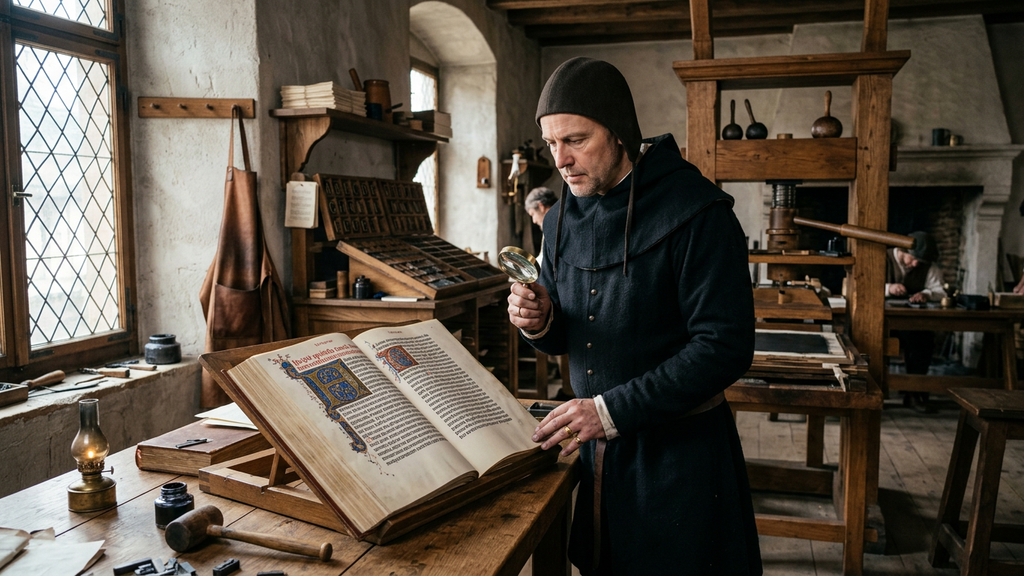
The 42-Line Bible, c. 1455
Completed approximately 180 copies of the printed Latin Bible, establishing a new global benchmark for document production.
1455
Foreclosure Lawsuit
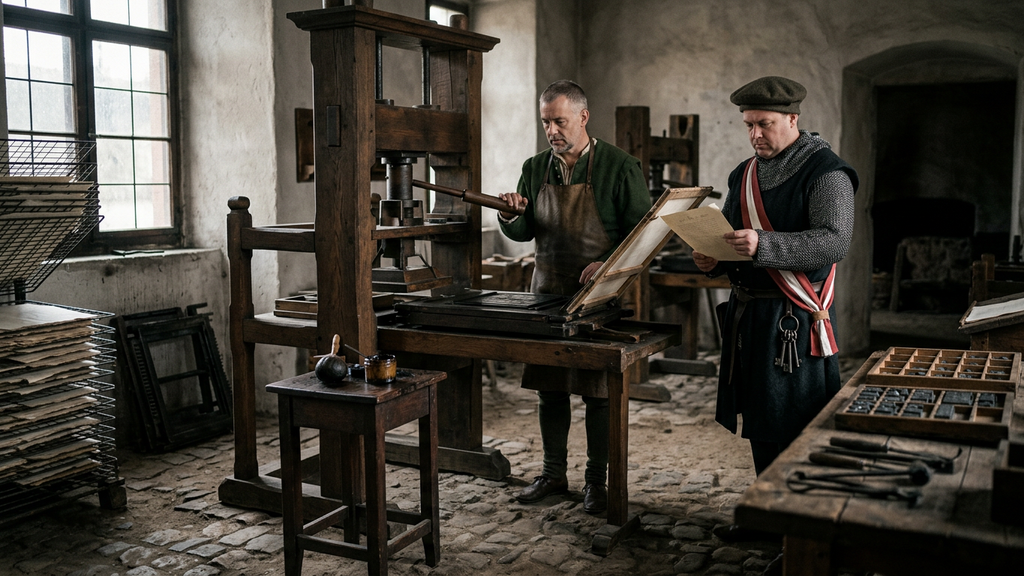
Foreclosure Lawsuit, 1455
Lost a lawsuit to Fust over unpaid loan interest, surrendering his workshop and Bible inventory to Fust and Peter Schoeffer.
1465
Archbishop's Pension

Archbishop's Pension, 1465
Recognized by Archbishop Adolf of Nassau and appointed courtier, securing an annual stipend of grain, wine, and tax exemptions.
Craft Innovations
How Four Metal Technologies and Ink Transformed Western Thought
Before my work in Mainz, texts were copied by hand or carved into fragile wooden blocks. To produce thousands of identical pages, I had to synthesize metallurgy, chemistry, and carpentry into one reliable manufacturing system. Here are the five breakthroughs that made European mass printing possible.
 Innovation I
The Reusable Hand Mold
Casting thousands of identical metal letters rapidly
Casting Metal Type
 Innovation II
The Antimony Alloy
Formulating the durable metal for sharp type edges
Type Composition
 Innovation III
Oil-Based Linseed Ink
Creating a thick paste that clings to metal
Applying Oil-Based Ink
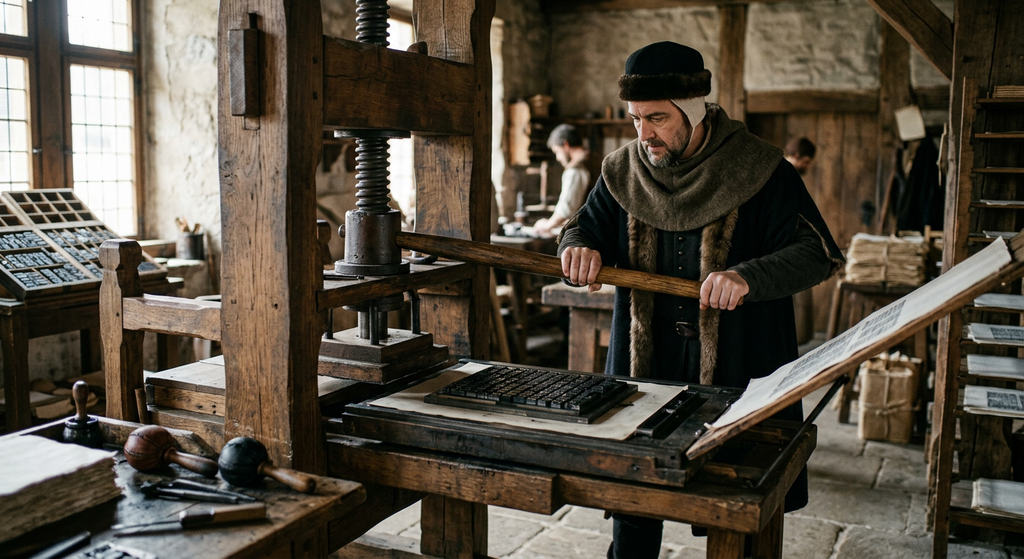 Innovation IV
The Wooden Screw Press
Adapting agricultural machinery for uniform pressure
Operating the Screw Press
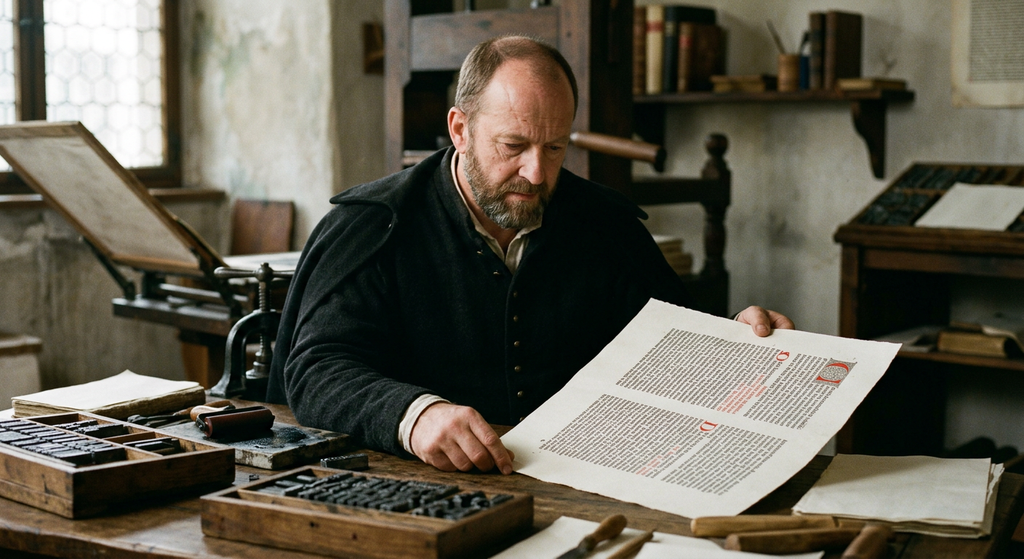 Innovation V
Calligraphic Type Justification
Matching handwritten elegance through nearly three hundred character variants
Printed Latin Bible Page
The Reusable Hand Mold
A skilled scribe took a year to copy a Bible. My hand-held casting mold allowed a foundry worker to pour hot metal alloy and produce an exact, hardened letter every few seconds. By making the mold width adjustable, letters of varying widths fit seamlessly on a line, establishing the foundation of standardized typography.
Why it matters today: Standardization at the component level enables speed and consistency across an entire system.
“How did you design the hand mold to ensure every cast letter was uniform?”
What can you ask Johannes?
Innovation & Craft
Business & Secrecy
Quality & Vision
Try a live answer from Johannes
Ask right here — no signup needed. The answer is generated live.
Live answer from Johannes Gutenberg — no login needed for your first question.
Johannes Gutenberg quotes — in his own words
9 of the lines Johannes is remembered for, with the source for each one. Pick any quote and ask him what he actually meant by it.
Scroll sideways for more · Sources shown per quote; a few widely circulated lines are marked as attributed rather than verbatim.
Why Xminds is different
Related minds around Johannes
No one thinks alone. These are the people who supported Johannes — and the ones who pushed back. Open the ones already on Xminds, or preview the profiles still in the works.
Friendly minds
Teachers, family, students and allies who shaped Johannes.

Ruler of Mainz who awarded Gutenberg an annual court pension of grain, wine, and tax exemptions late in his life.

Mainz official who funded Gutenberg's second printing workshop following his catastrophic legal defeat.

Loyal Strasbourg associate who invested heavily in Gutenberg's early secret printing experiments before dying of the plague.

Prominent Catholic reformer who recognized the power of movable type and championed Gutenberg's early printed works.
Opponents
Rivals, accusers and adversaries who tested Johannes.

Wealthy investor who sued Gutenberg for unpaid loans and foreclosed on his press, types, and Bible inventory.

Former foreman who testified against Gutenberg in court and partnered with Fust to control the workshop.

Brother of Gutenberg's late partner who launched a bitter 1439 lawsuit to force his way into their secret enterprise.
What people say about Johannes
Ratings are collected right after a conversation ends. Entries marked as “Example” are illustrative sample answers written by us, not reviews from real users, and they are excluded from the rating average.
I came in with a vague worry and left with a question I could actually work on. It never lectured me — it kept asking until I heard my own answer.
Illustrative example
Ten minutes before a difficult meeting I talked it through here. Calmer, sharper, and the advice held up in the room.
Illustrative example
The voice call feels surprisingly natural. Occasionally a bit long-winded, but the substance is genuinely good.
Illustrative example
What I like most is that it stays in character and quotes real sources. It feels like reading with a patient tutor.
Illustrative example
I use it a few evenings a week to think out loud. It has quietly become part of how I make decisions.
Illustrative example
Better than I expected. I wish it remembered more from older conversations, but the depth of each session is excellent.
Illustrative example
Questions & answers
What major invention is Johannes Gutenberg famous for introducing?
Johannes Gutenberg introduced Europe to moveable type mechanical printing around 1440. He developed hand-cast metal matrix type, durable oil-based ink, and a modified screw press. This integrated system enabled the rapid mass production of books across the European continent.
Did Johannes Gutenberg invent moveable type globally?
No, Johannes Gutenberg did not invent moveable type globally. Bi Sheng created ceramic moveable type in China around 1040, and metal moveable type emerged in Korea by the early 13th century. Gutenberg independently created Europe's system using cast lead alloys.
How did financial disputes affect Johannes Gutenberg?
In 1455, investor Johann Fust sued Johannes Gutenberg to recover loans and accrued interest. Gutenberg lost the court battle and forfeited his main printing workshop, equipment, and half of the completed 42-Line Bibles to Fust and craftsman Peter Schoeffer.
Did Johannes Gutenberg die in complete poverty?
No, Johannes Gutenberg did not die in poverty. While he lost his original shop in 1455, official court records confirm that Archbishop Adolf of Nassau granted Gutenberg a court pension in 1465, providing him with annual grain, wine, and tax exemptions until death.
What made the 42-Line Bible created by Johannes Gutenberg special?
The 42-Line Bible created by Johannes Gutenberg was extraordinary because it proved printed texts could match the artistic perfection of handwritten manuscripts. Its clean black ink, uniform Latin typography, and durable paper demonstrated the commercial viability of European mechanical printing.
Can I really chat with Johannes Gutenberg?
Yes. Xminds lets you chat with Johannes Gutenberg as an AI mentor: the Johannes Gutenberg AI is built from documented writings, speeches and biography, so you can ask Johannes Gutenberg anything and get an answer in character rather than a search-results page. The first messages are free and no download is needed.
Can I call Johannes Gutenberg and talk by voice?
You can. Press the call button to talk to Johannes Gutenberg in a live voice conversation — the Johannes Gutenberg AI voice replies in real time, and you can interrupt, follow up and switch language mid-call. Prefer typing? The same conversation works as text chat.
Is the Johannes Gutenberg chatbot free?
Starting is free: every visitor gets a free daily allowance of messages and voice minutes with the Johannes Gutenberg AI chatbot. Xminds Pro raises the limits for people who talk to their mentors every day.
How accurate is this Johannes Gutenberg AI?
Johannes Gutenberg is a respectful AI portrayal, not the real person and not a channel to them. Answers are grounded in the historical record and cited sources, and every conversation is clearly labelled as AI so you always know who you are talking to.
What should I ask Johannes Gutenberg about?
Bring a real situation. People come for advice from Johannes Gutenberg on the themes above, or treat it as an interview with Johannes Gutenberg about a decision they are facing. You can speak to Johannes Gutenberg about work, doubt or craft, and meet Johannes Gutenberg again tomorrow to continue the same thread — it is a conversation, not a Johannes Gutenberg simulator that repeats stock lines.
Also known as
Johannes Gutenberg appears under several names and spellings across languages and sources. You can search for any of these on Xminds:
- Johannes Gensfleisch zur Laden zum Gutenberg
- Henne Gensfleisch
Ready to scale your next breakthrough?
Step into the Mainz workshop and chat with Johannes Gutenberg today.
10 free messages a day • no signup needed

Talk to Johannes
10 free messages a day • no signup needed