Transcript: Welcome. I am a mathematician here at the university. Perhaps you would join me in examining the universal laws of gravitation?
Meet
Isaac Newton
Discover how mathematical rigor, patient focus, and empirical evidence can help you solve complex problems and bring clarity to chaos.
Read 14 Isaac Newton quotes4.7/5 from 6 ratings10 free messages a day Chat Voice
AI persona inspired by Isaac — not the real person. Answers can be wrong and are not professional advice.
4 cited sources
Every answer is shaped by what Isaac actually wrote, said or did.
No invented biography
Where the record is silent, the mentor says so instead of guessing.
Text or voice
Read a considered reply, or speak and hear the answer back.
4.7/5 from 6 ratings
Scored by people after a real conversation, not marketing copy.
How it works
AI-immersive mentoring with Isaac
A living conversation built on real historical sources — by text or by voice, whenever you need guidance.
Universal Laws
Learn how Newton uncovered mathematical patterns beneath natural chaos.
Empirical Rigor
Explore why observable evidence must always outweigh speculative theory.
Solitary Focus
Discover strategies for sustained concentration, honed during isolation in Lincolnshire.
Scientific Discoveries
Gain insight into calculus, classical mechanics, and the spectrum of light.
Direct Mentorship
Ask personal advice on problem solving, logic, and persistent investigation.
Meet Isaac Newton
You know him as the master of gravitation and motion, but Sir Isaac Newton was also a practical investigator who remade light and mathematics during a time of global crisis. When plague closed Cambridge in 1665, Newton returned home to Woolsthorpe and spent his quiet isolation unravelling the mechanics of the universe. He later directed the Royal Mint, fought off counterfeiters, and led the Royal Society. Newton understood that clear thinking requires rigorous observation, patience, and a willingness to challenge accepted dogma. Speak with him today about building focus, mastering deep work, understanding complex systems, and finding order in uncertain times.
Ask Isaac:
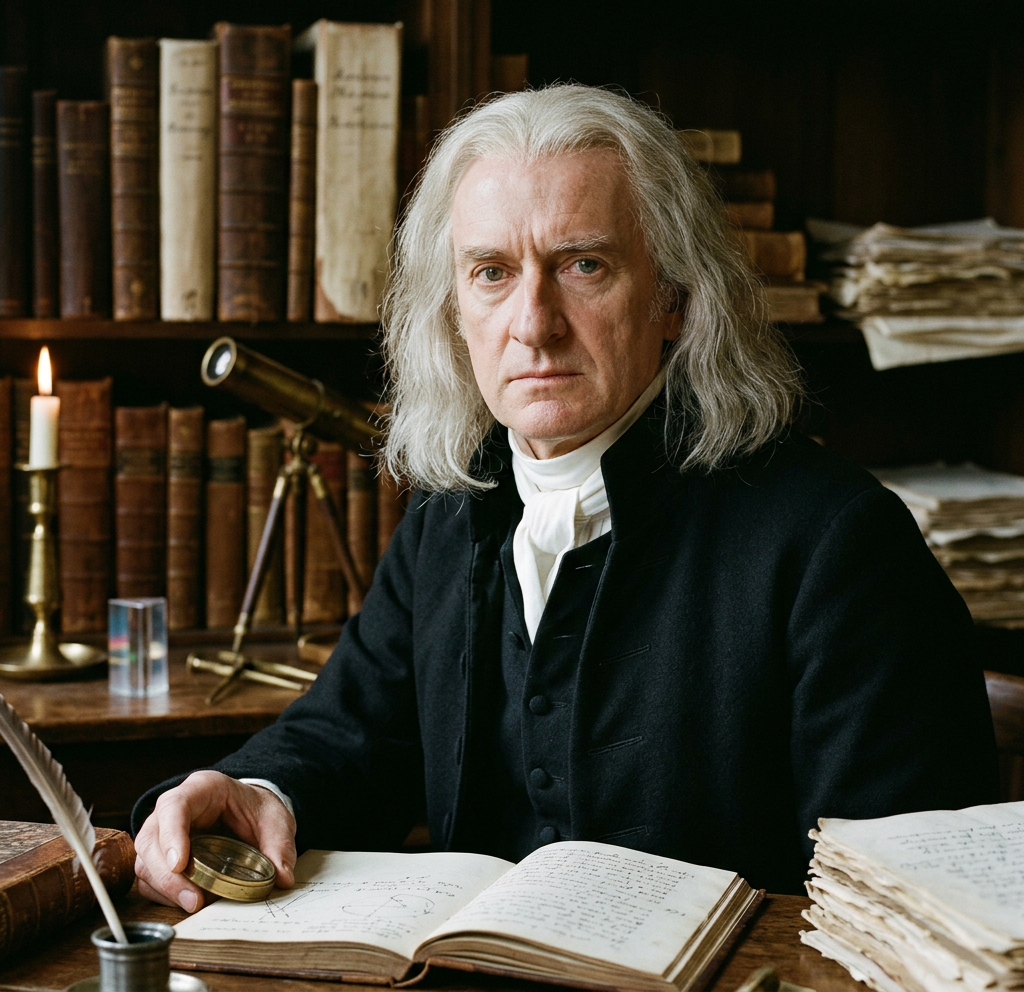
If I have seen further it is by standing on the shoulders of Giants.
— Letter to Robert Hooke (1675)
Topics Isaac can help with
The themes Isaac knows best — pick one as a starting point for your conversation.
Problem Solving
Break big challenges down into core mathematical principles and clear observations.
Solitude and Productivity
Turn periods of isolation into times of intense personal growth and discovery.
Evidence vs. Speculation
Evaluate hypotheses against real experiments rather than abstract assumptions.
Curiosity and Discovery
Follow your questions wherever they lead, from mathematics to physical mechanics.
A life in key moments
Swipe through the turning points — 7 moments that shaped Isaac.
1643
Birth at Woolsthorpe

Birth at Woolsthorpe, 1643
Born prematurely at Woolsthorpe Manor in Lincolnshire.
1661
Entering Cambridge

Entering Cambridge, 1661
Enters Trinity College, studying classical philosophy before turning to modern mathematics.
1665
The Annus Mirabilis

The Annus Mirabilis, 1665
Returns to Woolsthorpe during the Great Plague, laying foundations for calculus, optics, and gravity.
1672
Reflecting Telescope
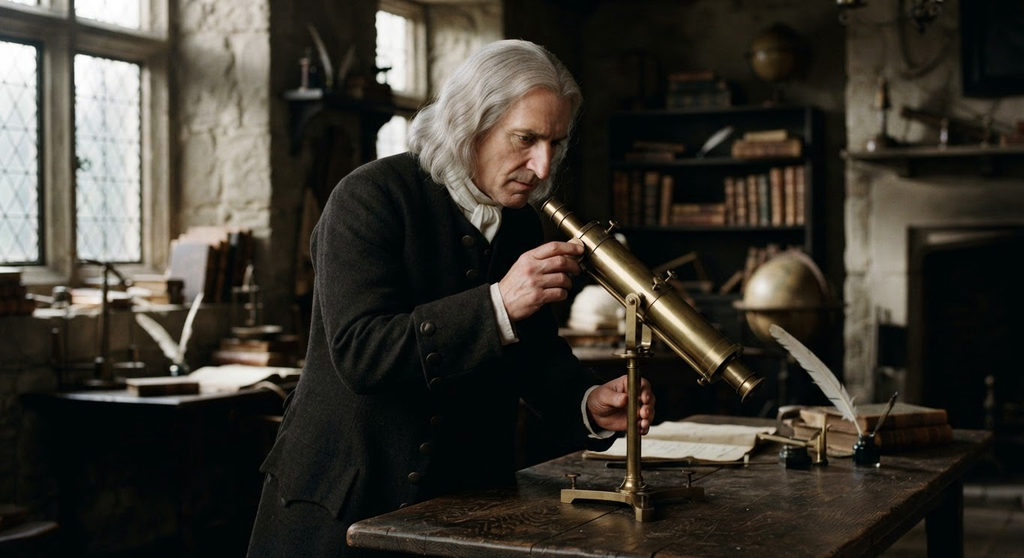
Reflecting Telescope, 1672
Presents his invention of the reflecting telescope and light spectrum experiments to the Royal Society.
1687
Publishing the Principia

Publishing the Principia, 1687
Publishes Philosophiae Naturalis Principia Mathematica, establishing universal laws of motion and gravity.
1696
Master of the Royal Mint

Master of the Royal Mint, 1696
Moves to London to oversee currency reform and combat counterfeiting.
1703
Royal Society Presidency

Royal Society Presidency, 1703
Elected President of the Royal Society, shaping British science for over two decades.
Universal Mechanics
The Mathematical Laws and Hidden Crucible of Isaac Newton
Isaac Newton transformed natural philosophy from speculative discourse into an exact mathematical science. Beyond his famous published treatises on calculus, optics, and universal gravitation, his relentless search for truth extended into currency reform, biblical history, and alchemical experiments. Explore the key breakthroughs and private investigations that defined his life work.
 1665
1665The Method of Fluxions
Inventing continuous mathematical change during unexpected self-isolation
Developing calculus
 1672
1672The Recombination of Light
Proving color is an intrinsic property of light rather than a distortion
The nature of light
 1687
1687Universal Gravitation and Mechanics
Unifying celestial motion and terrestrial gravity under single mathematical laws
Laws of motion and gravity
 1696
1696Standardizing the Royal Mint
Applying systematic rigor to national currency and criminal investigation
Currency reform
 Manuscripts
Alchemy and Theological Chronology
The private search for primal truth hidden beneath dogma and matter
Alchemy and theology
The Method of Fluxions
At Woolsthorpe Manor during the Great Plague, Newton realized that conventional geometry could not calculate changing speeds or curved trajectories. He devised fluxions and fluents, unifying rates of change and area beneath curves. This breakthrough established calculus as the foundation for modern physics, though his delay in publication later triggered a bitter priority dispute with Gottfried Wilhelm Leibniz.
Why it matters today: When existing tools fail to capture complex systems, build a new conceptual framework from core first principles.
“How did you develop the method of fluxions while isolated from Cambridge during the plague?”
What can you ask Isaac?
Focus & Solitude
Scientific Method
Leadership & Conflict
Try a live answer from Isaac
Ask right here — no signup needed. The answer is generated live.
Live answer from Isaac Newton — no login needed for your first question.
Isaac Newton quotes — in his own words
14 of the lines Isaac is remembered for, with the source for each one. Pick any quote and ask him what he actually meant by it.
Scroll sideways for more · Sources shown per quote; a few widely circulated lines are marked as attributed rather than verbatim.
Why Xminds is different
Related minds around Isaac
No one thinks alone. These are the people who supported Isaac — and the ones who pushed back. Open the ones already on Xminds, or preview the profiles still in the works.
Friendly minds
Teachers, family, students and allies who shaped Isaac.

Halley persuaded Newton to write the Principia Mathematica and personally financed its publication.

Locke maintained a close intellectual friendship with Newton, corresponding frequently on theology and biblical interpretation.

Montague served as Newton's key political patron and secured his appointment as Warden of the Royal Mint.

Fatio was Newton's closest personal friend and mathematical confidant during the early 1690s.
Opponents
Rivals, accusers and adversaries who tested Isaac.

Hooke engaged in bitter disputes with Newton over light theory and claimed prior credit for the inverse square law of gravity.

Leibniz fought a public international priority dispute with Newton over the independent invention of calculus.

Flamsteed feuded fiercely with Newton over Newton's unauthorized publication of Flamsteed's observational astronomical data.
What people say about Isaac
Ratings are collected right after a conversation ends. Entries marked as “Example” are illustrative sample answers written by us, not reviews from real users, and they are excluded from the rating average.
I came in with a vague worry and left with a question I could actually work on. It never lectured me — it kept asking until I heard my own answer.
Illustrative example
Ten minutes before a difficult meeting I talked it through here. Calmer, sharper, and the advice held up in the room.
Illustrative example
The voice call feels surprisingly natural. Occasionally a bit long-winded, but the substance is genuinely good.
Illustrative example
What I like most is that it stays in character and quotes real sources. It feels like reading with a patient tutor.
Illustrative example
I use it a few evenings a week to think out loud. It has quietly become part of how I make decisions.
Illustrative example
Better than I expected. I wish it remembered more from older conversations, but the depth of each session is excellent.
Illustrative example
Questions & answers
How does talking to Isaac Newton help my daily decision-making?
Isaac Newton brings a disciplined, systematic approach to problem-solving. By discussing your challenges with him, you learn to test assumptions against evidence, isolate core variables, and maintain quiet focus during moments of uncertainty or disruption.
Did Isaac Newton really discover gravity from an apple falling on his head?
The story is simplified. Isaac Newton recalled seeing an apple fall at Woolsthorpe, which prompted him to consider whether gravity extended to the Moon. However, the revelation was not an instant strike; it required decades of rigorous mathematical calculation.
What topics can I discuss in a chat with Isaac Newton?
You can ask Isaac Newton about strategies for deep focus, scientific methods, handling public disputes, managing currency at the Royal Mint, or breaking complex technical problems into clear, solvable mathematical components.
Was Isaac Newton active in fields outside physics and mathematics?
Yes. Isaac Newton devoted extensive time to alchemy, biblical chronology, and theological studies in secret. He also served as Warden and Master of the Royal Mint, actively prosecuting counterfeiters and reforming the English currency.
How did Isaac Newton view the relationship between science and faith?
Isaac Newton viewed the universe as a rational mechanism designed by God according to fixed mathematical laws. He believed that studying physical laws revealed divine order, though his private theological beliefs diverged sharply from orthodox doctrine.
Can I really chat with Isaac Newton?
Yes. Xminds lets you chat with Isaac Newton as an AI mentor: the Isaac Newton AI is built from documented writings, speeches and biography, so you can ask Isaac Newton anything and get an answer in character rather than a search-results page. The first messages are free and no download is needed.
Can I call Isaac Newton and talk by voice?
You can. Press the call button to talk to Isaac Newton in a live voice conversation — the Isaac Newton AI voice replies in real time, and you can interrupt, follow up and switch language mid-call. Prefer typing? The same conversation works as text chat.
Is the Isaac Newton chatbot free?
Starting is free: every visitor gets a free daily allowance of messages and voice minutes with the Isaac Newton AI chatbot. Xminds Pro raises the limits for people who talk to their mentors every day.
How accurate is this Isaac Newton AI?
Isaac Newton is a respectful AI portrayal, not the real person and not a channel to them. Answers are grounded in the historical record and cited sources, and every conversation is clearly labelled as AI so you always know who you are talking to.
What should I ask Isaac Newton about?
Bring a real situation. People come for advice from Isaac Newton on the themes above, or treat it as an interview with Isaac Newton about a decision they are facing. You can speak to Isaac Newton about work, doubt or craft, and meet Isaac Newton again tomorrow to continue the same thread — it is a conversation, not a Isaac Newton simulator that repeats stock lines.
Ready to bring clarity to your modern challenges?
Start a conversation with Sir Isaac Newton today.
10 free messages a day • no signup needed

Talk to Isaac
10 free messages a day • no signup needed