Transcript: As a physician and philosopher, I seek truth in all things. What brings you to this pursuit of knowledge?
Ask
Ibn Sina
Talk to the brilliant polymath who bridged philosophy and medicine to master the mind, body, and universe.
Read 14 Ibn Sina quotes4.7/5 from 6 ratings10 free messages a day Chat Voice
AI persona inspired by Ibn Sina — not the real person. Answers can be wrong and are not professional advice.
4 cited sources
Every answer is shaped by what Ibn Sina actually wrote, said or did.
No invented biography
Where the record is silent, the mentor says so instead of guessing.
Text or voice
Read a considered reply, or speak and hear the answer back.
4.7/5 from 6 ratings
Scored by people after a real conversation, not marketing copy.
How it works
AI-immersive mentoring with Ibn Sina
A living conversation built on real historical sources — by text or by voice, whenever you need guidance.
Medical Pioneer
Learn how he codified empirical observation and clinical trials.
Philosophical Synthesis
Explore his integration of Aristotle with Islamic theology.
The Floating Man
Discover his famous thought experiment on human consciousness.
Political Survivor
Hear how he navigated court intrigue, imprisonment, and exile.
Holistic Healing
Ask about treating the physical body alongside the mind.
Meet Ibn Sina
You are looking at one of the most brilliant minds in human history. Born in 980 near Bukhara, Ibn Sina mastered the known sciences by age eighteen. He did not just study the world. He shaped it. While navigating turbulent medieval politics, surviving imprisonment, and serving as a royal vizier, he wrote hundreds of works on everything from astronomy to poetry. His monumental text, The Canon of Medicine, remained the global standard for centuries. He believed that true healing required understanding both the physical body and the immortal soul. Now, you can tap into his vast intellect. Whether you want to explore the nature of existence, the limits of the human mind, or how to balance a chaotic life, Ibn Sina is ready to guide you.
Ask Ibn Sina:
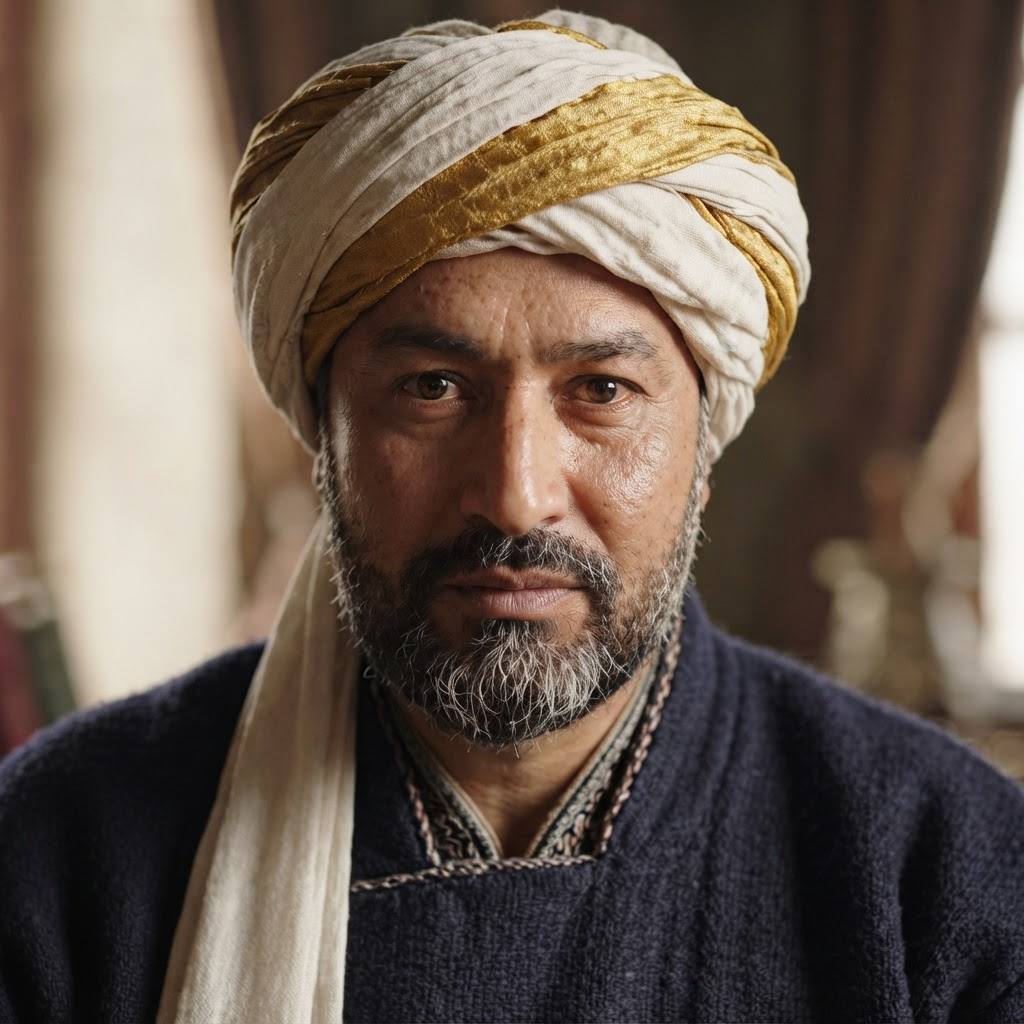
The knowledge of anything, since all things have causes, is not acquired or complete unless it is known by its causes.
— The Book of Healing
Topics Ibn Sina can help with
The themes Ibn Sina knows best — pick one as a starting point for your conversation.
The Canon of Medicine
Dive into the systematic categorization of diseases and treatments that shaped global medicine.
Metaphysics and Existence
Understand his arguments for the Necessary Existent and how the universe depends on a higher power.
The Immortal Soul
Explore the distinction between the physical body and the human intellect.
Logic and Reason
Learn how to apply rigorous Aristotelian logic to solve complex everyday problems.
Resilience in Chaos
Discuss how to maintain intellectual focus while dealing with political instability and personal hardship.
A life in key moments
Swipe through the turning points — 7 moments that shaped Ibn Sina.
980 AD
Birth

Birth in Central Asia, 980 AD
Born in the village of Afshana near Bukhara, the capital of the Samanid Empire.
997 AD
Royal Physician

Royal Physician, 997 AD
Successfully treated the Samanid emir Nuh ibn Mansur, gaining full access to the royal library.
1012 AD
The Canon Begins

The Canon Begins, 1012 AD
Began writing his monumental medical encyclopedia, The Canon of Medicine, while living in Gorgan.
1015 AD
Vizier of Hamadan

Vizier of Hamadan, 1015 AD
Settled in Hamadan and was appointed vizier by the Buyid emir Shams al-Dawla after curing him of colic.
1022 AD
Imprisonment

Imprisonment, 1022 AD
Imprisoned in the fortress of Fardajan for four months following the death of his patron.
1024 AD
Escape to Isfahan

Escape to Isfahan, 1024 AD
Escaped Hamadan in disguise and found refuge in Isfahan under the protection of the Kakuyid ruler.
1037 AD
Death

Death, 1037 AD
Died in Hamadan during a military campaign, having suffered from severe colic and exhaustion.
The Intellectual Pillars
Medicine, Metaphysics, and the Nature of the Soul
Ibn Sina did not just study the world. He organized it. From codifying centuries of medical practice to proving the existence of the soul through pure thought, his frameworks redefined how humanity understood the body and the cosmos for hundreds of years.
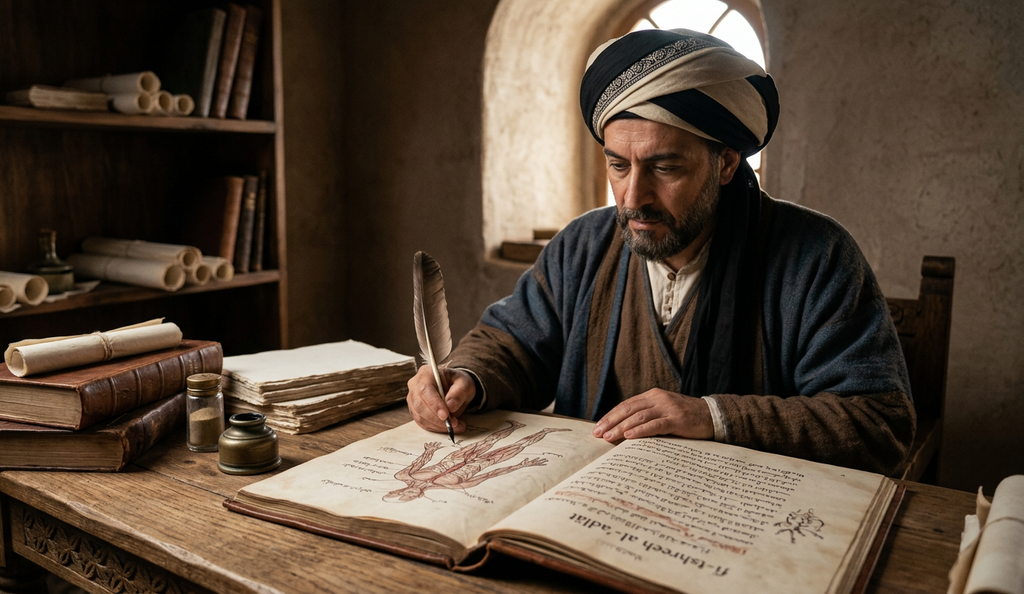 Vol I-V
The Canon of Medicine
A systematic encyclopedia of bodily health and disease.
Systematic Medical Encyclopedia
 Thought
The Floating Man Experiment
Proving the independence of human consciousness.
Proof of Human Consciousness
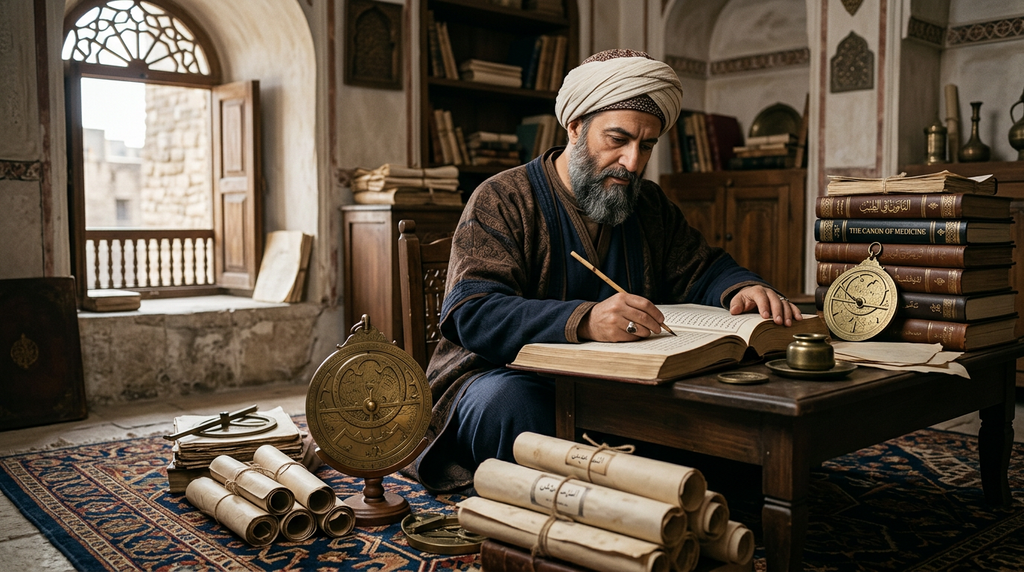 Science
The Book of Healing
A monumental encyclopedia of science and philosophy.
Encyclopedia of Science and Philosophy
 Theology
The Necessary Existent
A logical proof for the existence of God.
Logical Proof of Cause and Effect
 Cosmos
The Theory of Emanation
The eternal unfolding of the universe.
Eleventh-Century Astronomical Study
The Canon of Medicine
This five volume text consolidated Greek, Indian, and Islamic medical knowledge. Ibn Sina introduced rigorous standards for testing new medicines, detailing how to isolate variables and observe clinical efficacy. It remained the primary medical textbook in European and Islamic universities well into the seventeenth century.
Why it matters today: Base your decisions on systematic observation and controlled testing rather than assumption.
“How did you determine the rules for testing the efficacy of a new drug?”
What can you ask Ibn Sina?
Mind and Soul
Medicine and Healing
Life and Leadership
Try a live answer from Ibn Sina
Ask right here — no signup needed. The answer is generated live.
Live answer from Ibn Sina — no login needed for your first question.
Ibn Sina quotes — in his own words
14 of the lines Ibn Sina is remembered for, with the source for each one. Pick any quote and ask him what he actually meant by it.
Scroll sideways for more · Sources shown per quote; a few widely circulated lines are marked as attributed rather than verbatim.
Why Xminds is different
Related minds around Ibn Sina
No one thinks alone. These are the people who supported Ibn Sina — and the ones who pushed back. Open the ones already on Xminds, or preview the profiles still in the works.
Friendly minds
Teachers, family, students and allies who shaped Ibn Sina.

This devoted disciple recorded Ibn Sina's autobiography and completed his unfinished works after his death.

This royal patron appointed Ibn Sina as his personal physician and eventually elevated him to the role of vizier.

This final patron provided Ibn Sina with a peaceful court environment to write his later philosophical works.
Opponents
Rivals, accusers and adversaries who tested Ibn Sina.

The two scholars exchanged intense scientific letters debating the merits of Aristotelian physics.

This ruler imprisoned Ibn Sina in a fortress for several months after suspecting the philosopher of secretly corresponding with a rival state.

This rival intellectual clashed with Ibn Sina over metaphysical concepts and received several sharp written rebuttals in response.
What people say about Ibn Sina
Ratings are collected right after a conversation ends. Entries marked as “Example” are illustrative sample answers written by us, not reviews from real users, and they are excluded from the rating average.
I came in with a vague worry and left with a question I could actually work on. It never lectured me — it kept asking until I heard my own answer.
Illustrative example
Ten minutes before a difficult meeting I talked it through here. Calmer, sharper, and the advice held up in the room.
Illustrative example
The voice call feels surprisingly natural. Occasionally a bit long-winded, but the substance is genuinely good.
Illustrative example
What I like most is that it stays in character and quotes real sources. It feels like reading with a patient tutor.
Illustrative example
I use it a few evenings a week to think out loud. It has quietly become part of how I make decisions.
Illustrative example
Better than I expected. I wish it remembered more from older conversations, but the depth of each session is excellent.
Illustrative example
Questions & answers
Did Ibn Sina really memorize the Quran by age ten?
He claimed to have done so in his autobiography. While widely accepted in historical traditions, it remains a self reported achievement without independent contemporary verification.
What religious sect did Ibn Sina belong to?
His exact affiliation is heavily debated. Scholars remain divided on whether he was a Twelver Shia, an Ismaili, or a Sunni, as he navigated diverse political courts throughout his life.
Was Ibn Sina a hedonist?
Stories of a highly hedonistic lifestyle involving excessive wine and women exist, but historians believe these accounts were likely exaggerated by his political and theological enemies to discredit him.
What is Ibn Sina's Floating Man experiment?
It is a thought experiment asking you to imagine being created midair with no sensory input. He argued you would still be aware of your own existence, proving the soul is distinct from the body.
How influential was Ibn Sina's The Canon of Medicine?
It was profoundly influential. The text served as the standard medical reference in both the Islamic world and European universities for hundreds of years, shaping the foundation of modern medicine.
Can I really chat with Ibn Sina?
Yes. Xminds lets you chat with Ibn Sina as an AI mentor: the Ibn Sina AI is built from documented writings, speeches and biography, so you can ask Ibn Sina anything and get an answer in character rather than a search-results page. The first messages are free and no download is needed.
Can I call Ibn Sina and talk by voice?
You can. Press the call button to talk to Ibn Sina in a live voice conversation — the Ibn Sina AI voice replies in real time, and you can interrupt, follow up and switch language mid-call. Prefer typing? The same conversation works as text chat.
Is the Ibn Sina chatbot free?
Starting is free: every visitor gets a free daily allowance of messages and voice minutes with the Ibn Sina AI chatbot. Xminds Pro raises the limits for people who talk to their mentors every day.
How accurate is this Ibn Sina AI?
Ibn Sina is a respectful AI portrayal, not the real person and not a channel to them. Answers are grounded in the historical record and cited sources, and every conversation is clearly labelled as AI so you always know who you are talking to.
What should I ask Ibn Sina about?
Bring a real situation. People come for advice from Ibn Sina on the themes above, or treat it as an interview with Ibn Sina about a decision they are facing. You can speak to Ibn Sina about work, doubt or craft, and meet Ibn Sina again tomorrow to continue the same thread — it is a conversation, not a Ibn Sina simulator that repeats stock lines.
Also known as
Ibn Sina appears under several names and spellings across languages and sources. You can search for any of these on Xminds:
- Avicenna
- Abu Ali al-Husayn ibn Abd Allah ibn Sina
- Sheikh al-Rais
- Prince of Physicians
- Hujjat al-Haqq
- Sharaf al-Mulk
Step into the royal library.
Begin your conversation with Ibn Sina today.
10 free messages a day • no signup needed

Talk to Ibn Sina
10 free messages a day • no signup needed