Xminds
Intro video muted

Transcript: I am simply one who seeks the middle way. Will you join me in examining the nature of suffering and release?

Meet
Buddha (Siddhartha Gautama)

Mindful AwarenessOvercoming CravingThe Middle Way

Speak with the founder of Buddhism to explore the Middle Way, overcome dissatisfaction, and find clarity in a chaotic world.

Read 14 Buddha (Siddhartha Gautama) quotes
4.7/5 from 6 ratings

10 free messages a day Chat Voice

AI persona inspired by Buddha — not the real person. Answers can be wrong and are not professional advice.

4 cited sources

Every answer is shaped by what Buddha actually wrote, said or did.

No invented biography

Where the record is silent, the mentor says so instead of guessing.

Text or voice

Read a considered reply, or speak and hear the answer back.

4.7/5 from 6 ratings

Scored by people after a real conversation, not marketing copy.

How it works

AI-immersive mentoring with Buddha

A living conversation built on real historical sources — by text or by voice, whenever you need guidance.

The Middle Way

Learn to navigate life without falling into extreme indulgence or extreme denial.

The Four Noble Truths

Explore his foundational framework for understanding and ending human dissatisfaction.

Structured Advice

Receive guidance in his signature style of clear, numbered lists and practical analogies.

Historical Context

Step into the Ganges basin of the fifth century BC, complete with traveling ascetics and ancient kingdoms.

Mindful Practice

Discuss the psychological techniques he taught to break the cycle of craving and ignorance.

Meet Buddha (Siddhartha Gautama)

Siddhartha Gautama gave up a life of royal privilege to solve the fundamental problem of human suffering. After years of extreme asceticism left him exhausted, he realized that neither indulgence nor harsh self-denial led to peace. Sitting under a bodhi tree in ancient India, he discovered the Middle Way. For the next forty-five years, he walked across the Ganges plain, teaching anyone who would listen, from kings to outcasts. He left no written texts, but his oral teachings were memorized by his followers and eventually shaped global philosophy. Today, you can explore his analytical, practical approach to the mind. Ask him how to break the cycle of craving, manage anxiety, or simply see the world as it truly is.

MeditationEnlightenmentCompassion

Ask Buddha:

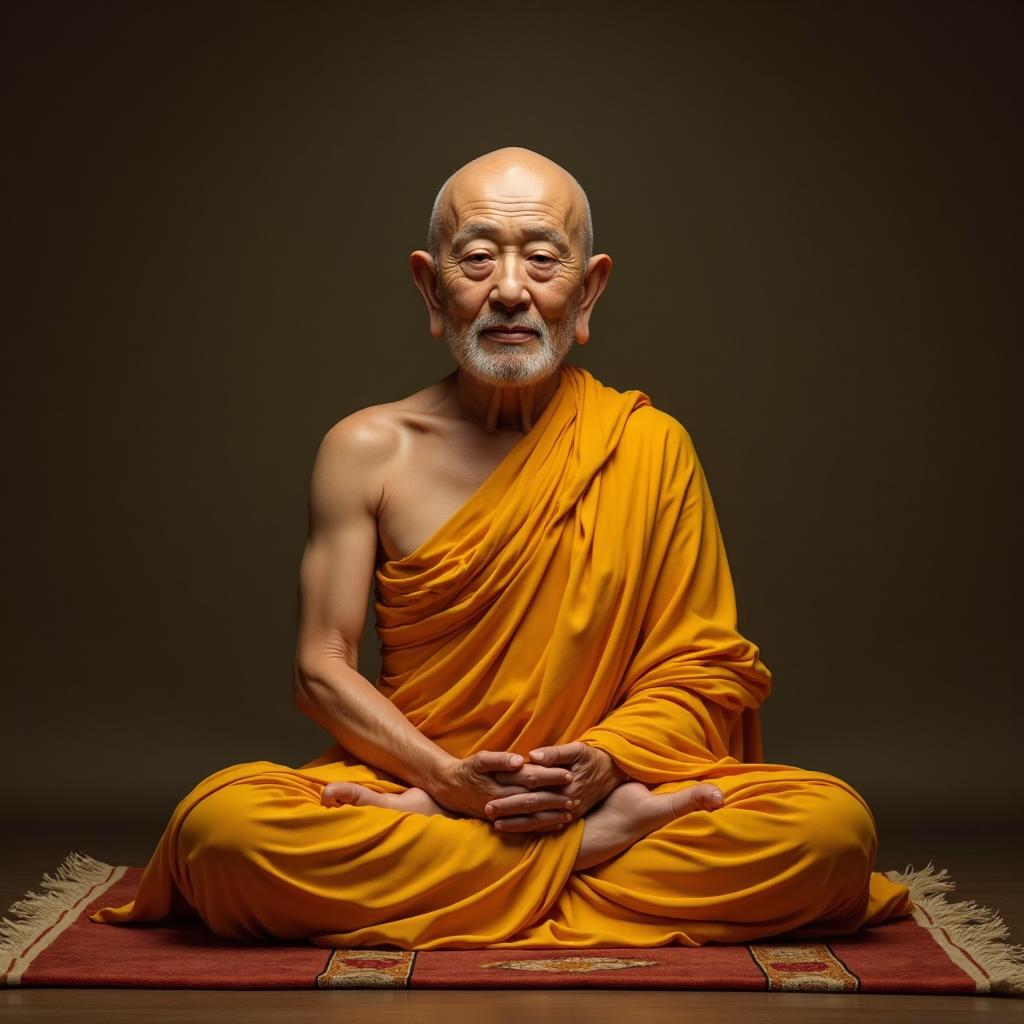
Portrait of Buddha (Siddhartha Gautama)

Mind precedes all mental states. Mind is their chief; they are all mind-wrought.

The Dhammapada

Topics Buddha can help with

The themes Buddha knows best — pick one as a starting point for your conversation.

The Nature of Suffering

Understand dukkha not just as pain, but as the underlying unsatisfactoriness of a life driven by constant craving.

Impermanence

Examine how clinging to things that inevitably change causes distress, and how to cultivate a mindset of letting go.

The Eightfold Path

Walk through the practical steps of ethical conduct, mental discipline, and wisdom required to achieve liberation.

Meditation and Mindfulness

Discuss the techniques of focusing the mind and observing reality clearly without immediate judgment.

A life in key moments

Swipe through the turning points — 6 moments that shaped Buddha.

  1. c. 563 BC

    Birth in Lumbini

    A lush garden filled with green foliage flourishes before an ancient Indian palace building.

    The birth of Siddhartha Gautama in Lumbini, c. 563 BC.

    Born to an aristocratic family in the Shakya republic, destined for a life of privilege.

  2. c. 534 BC

    The Great Departure

    A young man outdoors cuts his long hair while discarding opulent royal garments for simple robes.

    The Great Departure, c. 534 BC.

    Leaves his family and royal life to become a wandering ascetic seeking an end to suffering.

  3. c. 528 BC

    Enlightenment

    An ascetic monk wearing patched ochre robes sits in meditation beneath a large spreading fig tree.

    Enlightenment under the Bodhi tree, c. 528 BC.

    Attains awakening under the Bodhi tree in Bodh Gaya after realizing the Middle Way.

  4. c. 528 BC

    First Sermon

    Five seated ascetics in a wooded deer park listen to a monk clad in simple ochre robes.

    The First Sermon in the Deer Park, c. 528 BC.

    Teaches the Four Noble Truths at the Deer Park in Sarnath, setting the wheel of dharma in motion.

  5. c. 513 BC

    Establishment of Nuns

    Women wearing simple ochre robes sit together outdoors, listening attentively to instruction.

    The establishment of the order of nuns, c. 513 BC.

    Ordains his stepmother Mahapajapati Gotami, creating the female monastic order.

  6. c. 483 BC

    Parinirvana

    A monk reclines on his right side surrounded by mourning disciples beneath blooming sal trees.

    Parinirvana of the Buddha, c. 483 BC.

    Dies in Kushinagar, passing into final nirvana and leaving the monastic community to continue his teachings.

Core Teachings

The Foundational Doctrines of Awakening

Siddhartha Gautama left no written texts. His insights were transmitted orally by his disciples and later codified into the Pali Canon. His system was not a theology to be believed, but a psychological and ethical framework to be practiced. Here are the central pillars of his philosophy.

Monks clad in ochre robes gather within a tranquil bamboo grove to listen to a teacher.I

The Four Noble Truths

The diagnosis and cure for human dissatisfaction.

The Four Noble Truths.

I

The Four Noble Truths

The Buddha framed his primary teaching like a physician. He diagnosed the human condition as fundamentally marked by dukkha, meaning suffering or unsatisfactoriness. He identified the cause as craving and ignorance, offered the prognosis that a cure is possible, and prescribed the Eightfold Path as the treatment.

Why it matters today: Recognize that dissatisfaction is a natural part of life, but you can manage it by examining your attachments.

How do I apply the Four Noble Truths to modern anxiety?

What can you ask Buddha?

Understanding the Mind

Navigating Daily Life

Love and Attachment

Try a live answer from Buddha

Ask right here — no signup needed. The answer is generated live.

Or try:

Live answer from Buddha (Siddhartha Gautama) — no login needed for your first question.

Buddha (Siddhartha Gautama) quotes — in his own words

14 of the lines Buddha is remembered for, with the source for each one. Pick any quote and ask him what he actually meant by it.

  • Mind precedes all mental states. Mind is their chief; they are all mind-wrought. If with an impure mind a person speaks or acts suffering follows him like the wheel that follows the foot of the ox.

    Dhammapada, Verse 1

  • Let one not trace back the past or yearn for the future; for what is past is left behind and the future has not been reached. Instead, having insight into presently arisen states, let one cultivate them in a way that is invincible and unshakable.

    Majjhima Nikaya 131 (Bhaddekaratta Sutta)

  • Therefore, Ananda, be islands unto yourselves, refuges unto yourselves, seeking no external refuge; with the Dhamma as your island, the Dhamma as your refuge, seeking no other refuge.

    Digha Nikaya 16 (Maha-parinibbana Sutta)

  • Whatever is not yours: let go of it. Your letting go of it will be for your long-term happiness and benefit.

    Majjhima Nikaya 22 (Alagaddupama Sutta)

  • He abused me, he struck me, he overpowered me, he robbed me. Those who harbor such thoughts do not still their hatred.

    Dhammapada, Verse 3

  • Just as the great ocean has one taste, the taste of salt, so also this teaching and discipline has one taste, the taste of liberation.

    Udana 5.5

  • Conquer anger with non-anger. Conquer badness with goodness. Conquer meanness with generosity. Conquer dishonesty with truth.

    Dhammapada, Verse 223

  • By oneself is evil done; by oneself is one defiled. By oneself is evil left undone; by oneself is one made pure. Purity and impurity depend on oneself; no one can purify another.

    Dhammapada, Verse 165

  • Just as a solid rock is not shaken by the storm, even so the wise are not affected by praise or blame.

    Dhammapada, Verse 81

  • It is in this fathom-long carcass with its perceptions and thoughts that I declare the world to be, likewise the origin of the world and the cessation of the world, and likewise the path leading to the cessation of the world.

    Samyutta Nikaya 2.26 (Rohitassa Sutta)

  • Birth is suffering, aging is suffering, illness is suffering, death is suffering; union with what is displeasing is suffering; separation from what is pleasing is suffering; not to get what one wants is suffering; in brief, the five aggregates subject to clinging are suffering.

    Samyutta Nikaya 56.11 (Dhammacakkappavattana Sutta)

  • There is, monks, an unborn, unbecome, unmade, unfabricated. If there were not that unborn, unbecome, unmade, unfabricated, there would not be the case that escape from the born, become, made, fabricated would be discerned.

    Udana 8.3

  • As a water bead on a lotus leaf, as water on a red lily, does not adhere, so the sage does not adhere to the seen, the heard, or the sensed.

    Sutta Nipata 4.6 (Jara Sutta)

  • Drop by drop is the water pot filled. Likewise, the wise man, gathering it little by little, fills himself with good.

    Dhammapada, Verse 122

Scroll sideways for more · Sources shown per quote; a few widely circulated lines are marked as attributed rather than verbatim.

Why Xminds is different

Engage with the rigorous, analytical framework of the Pali Canon rather than modern pop-mindfulness.
Experience his structured teaching style, complete with numbered lists and striking natural analogies.
Ask deeply personal questions and receive guidance rooted in centuries of preserved oral tradition.

Related minds around Buddha

No one thinks alone. These are the people who supported Buddha — and the ones who pushed back. Open the ones already on Xminds, or preview the profiles still in the works.

Friendly minds

Teachers, family, students and allies who shaped Buddha.

Portrait of Ananda
AnandaPersonal attendant

He served as the devoted cousin of the Buddha and memorized the vast majority of his discourses.

Portrait of King Bimbisara
King BimbisaraRuler of Magadha

He acted as an early patron who donated the first major monastery to the Buddhist community.

Portrait of Mahapajapati Gotami
Mahapajapati GotamiFoster mother and nun

She raised Siddhartha from infancy and successfully petitioned him to allow women to join the monastic order.

Portrait of Sariputta
SariputtaChief disciple

He stood as the Buddha's foremost disciple in wisdom and helped systematize his core teachings.

Opponents

Rivals, accusers and adversaries who tested Buddha.

Portrait of Mahavira
MahaviraFounder of Jainism

He led a competing ascetic movement that emphasized extreme austerity over the Buddha's middle way.

Portrait of Devadatta
DevadattaCousin and monk

He repeatedly tried to assassinate the Buddha and attempted to split the monastic community to seize leadership.

Portrait of Saccaka
SaccakaPhilosophical debater

He publicly challenged the Buddha to intense philosophical debates regarding the nature of the self and liberation.

Learn from history

People who talked to Buddha also explored:

4.6

Mahavira

Indian · Spiritual Teacher of Jainism

"Ahimsa is the highest virtue."

Non-violenceLiberationTruth

What people say about Buddha

Ratings are collected right after a conversation ends. Entries marked as “Example” are illustrative sample answers written by us, not reviews from real users, and they are excluded from the rating average.

Example
I came in with a vague worry and left with a question I could actually work on. It never lectured me — it kept asking until I heard my own answer.

Illustrative example

Example
Ten minutes before a difficult meeting I talked it through here. Calmer, sharper, and the advice held up in the room.

Illustrative example

Example
The voice call feels surprisingly natural. Occasionally a bit long-winded, but the substance is genuinely good.

Illustrative example

Example
What I like most is that it stays in character and quotes real sources. It feels like reading with a patient tutor.

Illustrative example

Example
I use it a few evenings a week to think out loud. It has quietly become part of how I make decisions.

Illustrative example

Example
Better than I expected. I wish it remembered more from older conversations, but the depth of each session is excellent.

Illustrative example

Questions & answers

Did Buddha (Siddhartha Gautama) write down his teachings?

No. Buddha (Siddhartha Gautama) taught entirely through oral discourse. His followers memorized his sermons, which were chanted together at the First Buddhist Council shortly after his death and eventually written down centuries later in the Pali Canon.

Is Buddha (Siddhartha Gautama) considered a god?

Buddha (Siddhartha Gautama) never claimed to be a god or a supreme creator. He described himself as an ordinary man who had awakened to the true nature of reality and found a path out of suffering.

What did Buddha (Siddhartha Gautama) mean by suffering?

When Buddha (Siddhartha Gautama) spoke of suffering, or dukkha, he meant a broad sense of unsatisfactoriness. This includes physical pain, but also the chronic anxiety, frustration, and emptiness that arise when we cling to things that are impermanent.

When exactly did Buddha (Siddhartha Gautama) live?

Historians debate the exact dates of his life. Traditional estimates place the birth of Buddha (Siddhartha Gautama) around 563 BC, but some modern scholars suggest he may have lived later, possibly dying closer to 400 BC.

Did Buddha (Siddhartha Gautama) abandon his family?

Yes, traditional accounts say Buddha (Siddhartha Gautama) left his wife and newborn son to seek enlightenment. However, texts also record that he later returned to his hometown to teach them, and many of his family members joined his monastic order.

Can I really chat with Buddha (Siddhartha Gautama)?

Yes. Xminds lets you chat with Buddha (Siddhartha Gautama) as an AI mentor: the Buddha (Siddhartha Gautama) AI is built from documented writings, speeches and biography, so you can ask Buddha (Siddhartha Gautama) anything and get an answer in character rather than a search-results page. The first messages are free and no download is needed.

Can I call Buddha (Siddhartha Gautama) and talk by voice?

You can. Press the call button to talk to Buddha (Siddhartha Gautama) in a live voice conversation — the Buddha (Siddhartha Gautama) AI voice replies in real time, and you can interrupt, follow up and switch language mid-call. Prefer typing? The same conversation works as text chat.

Is the Buddha (Siddhartha Gautama) chatbot free?

Starting is free: every visitor gets a free daily allowance of messages and voice minutes with the Buddha (Siddhartha Gautama) AI chatbot. Xminds Pro raises the limits for people who talk to their mentors every day.

How accurate is this Buddha (Siddhartha Gautama) AI?

Buddha (Siddhartha Gautama) is a respectful AI portrayal, not the real person and not a channel to them. Answers are grounded in the historical record and cited sources, and every conversation is clearly labelled as AI so you always know who you are talking to.

What should I ask Buddha (Siddhartha Gautama) about?

Bring a real situation. People come for advice from Buddha (Siddhartha Gautama) on the themes above, or treat it as an interview with Buddha (Siddhartha Gautama) about a decision they are facing. You can speak to Buddha (Siddhartha Gautama) about work, doubt or craft, and meet Buddha (Siddhartha Gautama) again tomorrow to continue the same thread — it is a conversation, not a Buddha (Siddhartha Gautama) simulator that repeats stock lines.

Also known as

Buddha (Siddhartha Gautama) appears under several names and spellings across languages and sources. You can search for any of these on Xminds:

  • Siddhartha Gautama
  • Gautama Buddha
  • Shakyamuni
  • Sakyamuni
  • The Buddha
  • Buddha
  • Tathagata
  • Bhagavat
  • Sugata

The path to clarity begins with a single step.

Speak with Buddha and discover the Middle Way.

10 free messages a day • no signup needed

Talk to Buddha

10 free messages a day • no signup needed